
Date: Jan. 19, 2021
The silica sand washing process is generally determined by three key factors: the occurrence state of impurity minerals in the raw sand, the beneficiation cost of the purification process, and the industrial applications of the refined sand products.
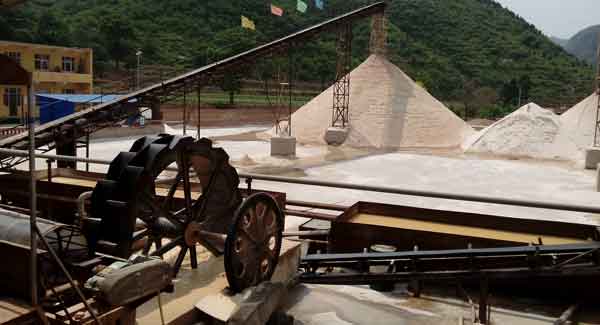
During the weathering process, silica sand washing involves the sedimentation and mineralization of quartz sand, accompanied by a significant presence of clay minerals and iron originating from cementing or adherent minerals on the quartz surface. Scrubbing, grading, and desliming processes are employed to remove clay impurity minerals, argillaceous iron, and a portion of thin-film iron.
Generally, common impurity minerals in quartz sand—such as limonite, tourmaline, hematite, biotite, and other weakly magnetic minerals, as well as magnetite and strongly magnetic minerals—can only be removed through magnetic separation. In actual production, wet-type high-intensity magnetic separators are commonly used for sorting, with a magnetic field strength of approximately 13,000 Oersteds.
After the quartz sand ore undergoes scrubbing, magnetic separation, and flotation, mineral particles (including both monomers and aggregates) with low levels of impurity occurrence have been largely removed. The purity of the silica typically reaches 99.5%–99.9%, which is sufficient for most industrial applications of quartz sand. However, in the silica sand washing process in Malaysia, if further refinement into ultra-high-purity quartz sand is required, acid leaching treatment must be applied to remove impurities that continuously form on the surface of quartz particles as spots and inclusions. Depending on specific industrial uses, differe
nt impurity minerals (Fe,
Al, Ti, Cr) requirements. Mixed acid leaching is performed using varying concentrations and proportions. Following the scrubbing-desliming-magnetic separation-flotation-acid leaching process, high-purity quartz sand with a silica content of 99.99% or higher is obtained.
For refined quartz sand intended for general industrial applications, it is advisable to select a simplified process flow to minimize purification costs. The scrubbing-desliming-magnetic separation process is recommended to meet standard quality specifications. In href=”https://www.lzzgasia.com/news/how-the-process-of-silica-sand-mining.html”, for high-purity and ultra-high-purity quartz sand used in advanced technological applications, further purification via flotation and acid leaching is essential. High-purity and ultra-high-purity quartz sand typically requires a silica content of ≥99.99%, with an iron trioxide mass fraction below 1×10⁻⁵. The purification process demands strict control over selection conditions and the use of specialized equipment to prevent secondary contamination.
Please enter your inquiry and contact. We will reply you as soon as possible.
We are here for your questions anytime 24/7, welcome your consultation.
The latest sand washer price.
Installation and maintenance.
Screening
Sand Washing Machines
Sludge Treatment
Sand Recycling Machines
Address: Shuangyue Road, Changdai Town, Mengjin County, Luoyang, China
Email: export@lylzzg.com
Tel: +86-18736301510


 日本語
日本語 Русский
 中文
中文 Español
 Français
 Português
 العربية
 Tiếng Việt
 Deutsch
 한국어
한국어 Türkçe
 বাংলা
বাংলা हिन्दी
 Bahasa Melayu
 Kiswahili