
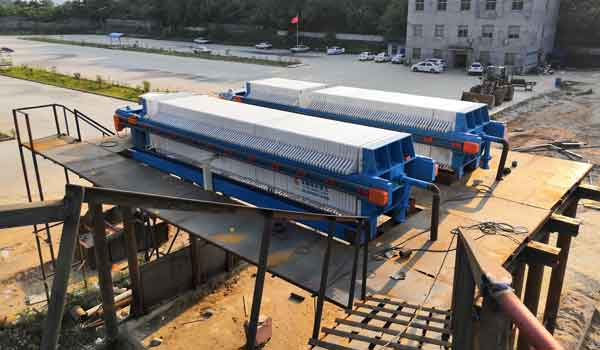
How to Improve the Working Efficiency of Frame Filter Presses
Date: Sep. 18, 2021
The frame filter press is a critical piece of water treatment equipment, widely adopted across Europe and the Americas. Enhancing the operational efficiency of plate and frame filter presses remains a key concern for many users. This article outlines several effective strategies to boost performance. 1. Feed Size Impacts Work Efficiency In some sand washing or coal preparation plants, centrifuges and other auxiliary equipment operate in conjunction with filter presses to establish a closed-circuit process for material recovery and screening. When the screening and washing system operates coarsely, part of the thickener underflow can be strategically directed to the centrifuge to recover coarse materials. The resulting centrifuged liquid is then returned to the filter press as feed. This approach optimizes the particle size distribution entering the filter press and improves its overall working conditions. 2. Feed Concentration Impacts Operational Efficiency Theoretically, a higher feed concentration for the results in shorter cycle times, thereby sustaining greater processing capacity. This approach helps achieve optimal cake moisture levels and lower solid content in the filtrate. However, excessively high underflow concentrations can pose risks to the safe and stable operation of the thickener. Therefore, Longding Environmental Technology recommends maintaining the feed concentration within the range of 400–600 g/L. This ensures that both the required feed density for the and the normal operation of the thickener (specifically, the high-efficiency deep cone thickener) are effectively maintained. 3. Feeding Pressure Impacts Operational Efficiency Feed pressure is the primary driving force in the process. Higher feed pressure generally results in faster filtration speeds. However, excessive pressure can accelerate equipment wear. Therefore, during the initial feeding stage of a plate and frame , it is recommended to maintain low…
Date: Sep. 18, 2021
In the production of machine-made sand, href="https://www.lzzgasia.com/products/sand-washing-machines" washed by the sand washing machine is cleaner and offers superior quality. Consequently, the sand washer has become a critical piece of equipment in artificial sand production lines. However, operational faults may occur during use. This article outlines common issues users might encounter with sand washers and provides corresponding solutions. href="https://www.lzzgasia.com/wp-content/uploads/17.jpg" src="https://www.lzzgasia.com/wp-content/uploads/17.jpg" Issue 1: Inadequate Sand Cleaning Solution: During the sand washing process, first activate the flushing pipe before introducing the material. Maintain an optimal water flow rate to ensure thorough cleaning while preventing sand overflow from the trough. Feed materials uniformly and at a controlled pace; excessive speed can compromise sand quality. Issue 2: Reduced Washing Capacity or Sand Leakage Root Cause: Damage to the sand screen mesh or detachment of its fixing bolts. Solution: Inspect the screen mesh for damage, then repair or replace it as necessary. Ensure all fixing bolts are securely tightened. Issue 3: Excessive Bearing Temperature Root Cause: Contaminated grease or incorrect grease quantity. Solution: Replace the grease. Ensure the amount is optimal—avoid over-greasing or under-greasing. Issue 4: Flipping Phenomenon During Sand Washing Root Cause: The spiral sand washer speed is too high, or the horizontal axis of…
Date: Sep. 10, 2021
Many customers put vibrating screens directly into production upon delivery without first verifying equipment performance. This often leads to various operational issues over time. This article outlines essential maintenance practices for vibrating screens. Daily Maintenance of Vibrating Screens (1) Before starting the equipment, check bearing lubrication and screen tension. An overly loose screen can cause local deflection and bulging, leading to premature wear and reduced screening efficiency. (2) Monitor transmission belt tension before startup and during operation. Improper tension can decrease the vibrating screen's productivity and even cause complete screen blockage. (3) Carefully inspect all bolt connections on the sieve machine and transmission device. (4) Lubricate the rolling bearings of adjustable linear vibrating screens with molybdenum disulfide or yellow glycerin. In winter, add 25% engine oil to the lubricant. (5) The allowable temperature rise of the bearings in the adjustable linear vibrating screen must not exceed 75°C, as excessive heat can compromise bearing performance. Factors such as incorrect lubricant selection, improper oil levels, dust ingress into the bearings, or faulty installation may also adversely affect them. Therefore, it is essential to strengthen bearing maintenance during operation. (6) The adjustable linear vibrating screen generates a significant amount of dust. To improve…
Date: Sep. 08, 2021
What knowledge do I need to know about sand washing machines when ordering sand washing machines? Many new entrants are not sure. But for old customers, it is not difficult, what should be paid attention to during the purchase process? This article analyzes it for you. 1. Definition of sand washing machine Sand washing machines can be divided into two types from the perspective of use. One is the sand washing system: this is a sand washing machine in a broad sense, with a wide range of applications, used in on-site mixing plants and various key projects. Another sand washing machine equipped with a sand machine has limitations in actual use. Generally speaking, the sand washing machine is not only used for washing sand but also widely used for washing impurities. For example, the sand in the sandstone and weathered sand is called "washed sand". 2. Classification of Sand Washing Machines Sand washing machines are primarily categorized into screw and bucket wheel types, designed to remove impurities from stone materials and enhance product purity. While some models offer high cleanliness and large output, they often suffer from significant sand and gravel loss. LZZG’s bucket wheel sand washing machines produce cleaned…
Date: Sep. 04, 2021
A spiral classifier is a device that classifies solid particles based on their different sedimentation speeds in the slurry. Spiral classifiers are generally categorized into high-weir types and submerged types. How should users make the right choice for production? Let’s explore this together. 1. Selection Based on the Number of Blades A higher number of blades increases the classification area, facilitating better performance under demanding operational conditions. However, it also adds complexity to the equipment design. Therefore, unless specific requirements or constraints related to the mineral pulp dictate otherwise, it is advisable to use fewer blades whenever possible. 2. Selection Based on Grinding Fineness The height of the overflow weir in a spiral classifier directly influences the effective sedimentation area for ore particles. In practice, the selection should be aligned with the required grinding fineness specifications. The height H of the overflow weir on a high-weir spiral classifier is 1/4–3/8 of the spiral diameter D. This configuration is primarily used for ore classification with an overflow particle size of 0.83–0.15 mm. For submerged spiral classifiers, the height H is 3/4–1 of D, making them suitable for ore classification with an overflow particle size of 0.15–0.07 mm. 3. Select Based on…
We are here for your questions anytime 24/7, welcome your consultation.
The latest sand washer price.
Installation and maintenance.
Screening
Sand Washing Machines
Sludge Treatment
Sand Recycling Machines
Address: Shuangyue Road, Changdai Town, Mengjin County, Luoyang, China
Email: export@lylzzg.com
Tel: +86-18736301510


 日本語
 Русский
 中文
 Español
 Français
 Português
 العربية
 Tiếng Việt
 Deutsch
 한국어
 Türkçe
 বাংলা
 हिन्दी
 Bahasa Melayu
 Kiswahili