
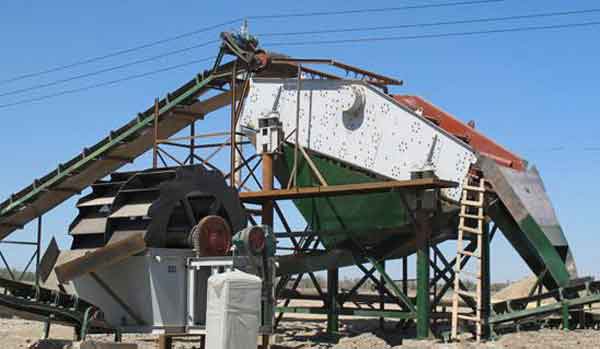
How to Improve the Screening Efficiency of Vibrating Screens
Date: Oct. 16, 2021
Vibrating screens are indispensable equipment in the sand washing industry. The efficiency of a vibrating screen directly impacts overall operational performance. Low screening efficiency leads to unnecessary waste and reduces enterprise profitability. Improving vibrating screen efficiency is a key concern for many customers, which this article addresses. Factors affecting the screening efficiency of the vibrating screen: material factors, equipment factors. Among them, the material factors include the moisture content, bulk density, particle size, and particle shape that affect the screening effect. 1. Material moisture content During dry screening, materials with high moisture content or good wettability and adhesion are more likely to agglomerate, causing blockage of the screen holes and greatly reducing the screening efficiency. 2. Material bulk density When the bulk density of the material is large, the screening capacity of the vibrating screen is proportional to the bulk density. 3. Material Size The higher the proportion of particles capable of passing through the mesh, the easier it is to screen the material; conversely, screening becomes more difficult. Particles with a size d=1~1.5a (where a is the aperture size) tend to get stuck in the mesh of the , a phenomenon known as blinding or obstruction. These granules hinder the material from passing through the sieve. Therefore, the greater the amount of difficult-to-screen and obstructive particles in the feed, the lower the screening efficiency of the . 4. Particle Shape Spherical particles pass easily through square and round mesh openings. In contrast, strip-like, flaky, or polygonal particles find it more difficult to pass through square and round apertures but move more readily through rectangular sieve holes. Beyond material properties and equipment specifications, several factors influence vibratory screening outcomes. Reputable…
Date: Oct. 08, 2021
Mineral resources are a vital material foundation for economic and social development. As key basic raw materials, sand and gravel aggregates see global annual production and consumption of approximately 40 billion tons, with China accounting for nearly half of this total. Against the backdrop of China’s current economic and social progress—particularly during the accelerated urbanization process—the aggregate industry holds a pivotal strategic position. For operators of sand and gravel plants, how well do you understand the fundamentals of gravel aggregates? Below, LZZG provides an overview of sand and gravel aggregates[[/T0]]. 1. What key factors should be monitored when receiving coarse and fine aggregates? For coarse aggregate, primary control points include particle size, gradation, particle shape, stone powder content, mud content, and clay lumps. Each delivery vehicle must undergo a visual inspection; unqualified loads are prohibited from being unloaded. Additionally, all indicators must be tested in batches according to specification requirements. For fine aggregate, control focuses on fineness modulus, mud content, and clay lump content. Similarly, each vehicle requires a visual inspection, with non-compliant loads rejected upon arrival. Batch testing per specification standards is also mandatory. 2. Why must the coarse aggregate particle size be limited to 5–25 mm? The maximum…
Date: Oct. 08, 2021
A spiral sand washing machine is primarily designed to remove impurities from mined sand and stone, typically utilizing a water-based washing process. This equipment integrates three key functions: cleaning, dewatering, and grading. It is widely applied in construction sites, sand and gravel plants, concrete dam projects at hydropower stations, precast concrete facilities, glass manufacturing plants, and for preparing pressure sand used in oil well backfilling. Even after acquiring a high-quality spiral sand washer, improper or inaccurate installation will prevent the machine from performing effectively. The adjustment of the spiral sand washing machine’s installation angle directly impacts sand production efficiency. Therefore, what critical issues must be addressed during the installation of the sand washer, and which factors influence the optimal installation angle? This article provides a detailed analysis for our readers. Spiral Sand Washing Machine Installation 1. Upon delivery of the spiral sand washer, users should immediately inspect the unit to ensure all parts are complete and undamaged. Installation should only proceed after confirming that the machine is intact. 2. The user should design the foundation construction drawing for the stone washing machine based on specific site conditions, ensuring the machine is securely installed on a solid concrete foundation. 3. During…
Date: Sep. 29, 2021
Daily maintenance of sand washer equipment is critical, encompassing but not limited to the upkeep of key components. Proper lubrication is particularly vital for sand washing machines. Neglecting maintenance over extended periods can lead to rust formation and hinder smooth operation. In severe cases, this may result in mechanical failures, causing downtime and impacting production efficiency. Therefore, this section outlines the specific requirements for lubricants used in sand washing machine equipment. 1. Due to the small oil tank capacity of sand washing machines, the volume of lubricating oil that can be accommodated is relatively limited. Additionally, operating temperatures tend to rise during use, necessitating lubricants with excellent thermal stability and oxidation resistance. Given the harsh working environments typical for sand washer equipment—characterized by high levels of coal dust, rock dust, and moisture—the lubricating oil is inevitably exposed to contamination from these impurities. Consequently, the lubricant must demonstrate superior anti-rust, anti-corrosion, and demulsification properties. 2. For operating in open-pit mines, seasonal temperature fluctuations must be carefully monitored. In many regions, significant diurnal temperature variations also occur. Therefore, select lubricating oils with low viscosity-temperature sensitivity to ensure consistent performance. High temperatures can reduce oil viscosity excessively, preventing the formation of an adequate…
Date: Sep. 25, 2021
Sludge thickening increases the sludge concentration from approximately 1% to 3–4%. Sludge dewatering removes most of the water from sludge with a concentration of about 3%, significantly increasing its dryness. There is a substantial difference in effectiveness between these two processes. Today, the LZZG Technical Department will guide you on how to distinguish between sludge dewatering and sludge thickening. Sludge Thickening The sludge thickening process typically involves three methods: gravity concentration, mechanical concentration, and dissolved air flotation (DAF) concentration. Among these, gravity concentration—which utilizes natural gravity to separate liquid from sludge—is widely applied. Sludge thickening is a process that employs gravity or air flotation to reduce the moisture content and increase the density of the sludge. It serves as an effective method for lowering sludge moisture content and reducing sludge volume. Primarily, sludge thickening targets the reduction of interstitial water within the sludge. The resulting thickened sludge resembles a paste yet retains fluidity. While it represents the most economical and efficient approach to minimizing sludge volume, thickening generally cannot reduce the sludge moisture content to below 90%. Commonly Used Sludge Thickening Equipment The LZZG High-Efficiency Deep Cone Thickener is based on traditional vertical flow sedimentation equipment. The internal barrel structure…
We are here for your questions anytime 24/7, welcome your consultation.
The latest sand washer price.
Installation and maintenance.
Screening
Sand Washing Machines
Sludge Treatment
Sand Recycling Machines
Address: Shuangyue Road, Changdai Town, Mengjin County, Luoyang, China
Email: export@lylzzg.com
Tel: +86-18736301510


 日本語
 Русский
 中文
 Español
 Français
 Português
 العربية
 Tiếng Việt
 Deutsch
 한국어
 Türkçe
 বাংলা
 हिन्दी
 Bahasa Melayu
 Kiswahili