
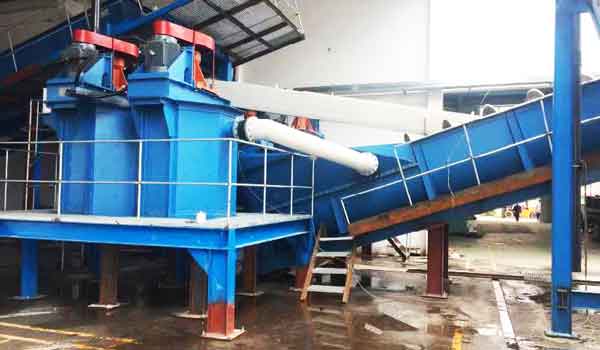
How to Choose a Suitable Silica Sand Double Tank Scrubbing Machine
Date: Oct. 29, 2021
How to buy a silica sand double tank scrubber? First, we need to understand that the silica sand scrubbing machine and the double-slot scrubbing machine not only reduce occupied space and volume but also minimize noise and vibration. The scrubbing machine is suitable for processing high-concentration materials, with a maximum scrubbing concentration reaching 75%, making it highly practical. This new type significantly improves material scrubbing efficiency and surface cleaning effectiveness, achieving a qualification rate of nearly 100%. Secondly, it is essential to grasp the structural characteristics. A double-slot silica sand scrubbing machine designed for cleaning material surfaces includes a frame housing two scrubbing tanks. Each tank is equipped with large and small impeller stirring devices. Notably, each stirring device is connected to its own direct-drive motor, which is mounted on the scrubber’s frame. 1. Structure and Principle of Silica Sand Scrubbing Machine This unit features a dual-tank design, with each tank equipped with an independent transmission system. Each tank is driven by a motor via a V-belt, rotating the main shaft at high speed. Two high-speed impellers are mounted on each main shaft in opposing directions, generating distinct axial thrusts and varying mixing intensities. The main shaft offers two structural configurations; its installation orientation is determined by the ore slurry flow direction, ensuring that the scrubbing force aligns precisely with the flow path. During the scrubbing process, the mineral fluid within the silica sand slurry scrubber is first forcefully propelled by the upper impeller and then driven in the opposite direction by the lower impeller. This causes the material to undergo intense collision between the two impellers under opposing thrusts, generating friction. Dirt, impurities, and oxides adhering to the material…
Date: Oct. 26, 2021
The sand washing machine removes impurities from the surface of the sand and disrupts the water vapor layer covering it, facilitating dehydration and ensuring efficient washing and cleaning. Long-term operation can lead to a series of issues that ultimately affect the output of the sand washer. Understanding how to resolve these problems and maintain optimal output is a key concern for many customers. This article summarizes methods to increase the output of sand washers and address common failures. Common faults and solutions for sand washers By understanding common faults in sand washers, operators can avoid uncertainty when equipment unexpectedly stops running. Timely identification and resolution of issues significantly enhance the effectiveness of the sand washer. 1. Noise in the transmission system of the sand washing machine, caused by insufficient gear lubrication or changes in gear spacing. Solution: Add adequate grease and adjust and tighten the anchor bolts of the reducer. 2. Gear failure is often caused by damage resulting from inadequate maintenance of the sand washer. Specifically, the parallelism between the sand washer shaft and the reducer’s low-speed shaft does not meet the required specifications. Solution: Lubricate at the specified intervals and adjust components to ensure they meet alignment requirements.…
Date: Oct. 22, 2021
During stone cleaning operations, the sand washing machine is subjected to impact from stones and erosion by water. Over time, this inevitably leads to varying degrees of wear and tear, causing inconvenience in subsequent cleaning tasks. So, what are the primary causes of sand washing machine wear during operation? Reasons for Wear in Sand Washing Machines As a leading manufacturer of sand washing equipment, LZZG has provided comprehensive customer services for many years. Through extensive research, we have identified that wear in sand washers is influenced by multiple factors. Primarily, two key reasons contribute to this issue. First, friction and vibration within the equipment can alter the original position and dimensions of its components, leading to changes in shape, fit performance, accuracy, and potential part damage. It is important to note that wear patterns vary across different models of sand washing machines; therefore, users should conduct specific analyses based on their individual operational conditions. Second, some manufacturers attempt to boost production efficiency by overloading the equipment beyond standard specifications. This non-compliant operation accelerates the wear process significantly. Summary of Causes and Solutions for Sand Washing Machine Wear 1. Prolonged Contact with Sand and Gravel Materials Wear issues affecting the main…
Date: Oct. 22, 2021
The working principle of the shaftless trommel involves mounting its roller device on a frame at an incline, utilizing a non-central shaft structural design. The motor drives rotation either by meshing a pinion gear with the drum’s large gear or via a chain drive engaging gears on the drum. Alternatively, the motor can drive the chain directly, or the drum may be supported by two idlers, which are driven by the motor to rotate the drum. As the drum rotates under the driving mechanism, material entering the screen surface is turned and rolled due to the drum's inclination and rotation. Qualified materials (undersize products) discharge through the outlet at the bottom rear end of the drum, while unqualified materials (oversize products) exit through the discharge port at the drum's end. The continuous tumbling and rolling action within the drum helps eject any material stuck in the screen openings, effectively preventing blockages. Application range of shaftless trommel Shaftless trommel is mainly used for grading processing of belt-shaped and strong winding materials and is widely used in electric power, mining, metallurgy, building materials, chemical, and other production industries. It is often used for the classification of refractory materials, coal, fertilizers, and stones…
Date: Oct. 16, 2021
Why is sludge dewatering necessary? This is a common question among our customers. Here, we analyze the key reasons for deep sludge dewatering. Without proper dewatering, industrial sludge becomes difficult to handle and transport, leading not only to environmental pollution but also to a cascade of operational challenges. 1. **Significant Benefits of Deep Dewatering** Sludge generated by sewage treatment plants, chemical facilities, and industrial enterprises typically has a moisture content exceeding 90%, sometimes reaching as high as 99%. In this fluid state, the sludge occupies large volumes, spreads easily, and poses significant challenges for transportation and storage. Therefore, reducing moisture content and volume is essential. LZZG’s sludge press dryer can reduce sludge moisture content to between 15% and 50%. For instance, sludge with an initial moisture content of 95% can be processed down to 40%, resulting in an 11-fold reduction in volume—demonstrating the clear effectiveness of this technology. 2. Deep sludge dehydration effectively eliminates odors, pathogens, and other harmful substances. The process produces a dry, hard mud cake with extremely low moisture content. As harmful substances are removed along with the extracted water, the resulting mud cake is non-sticky, has a dry surface, and is odorless, thereby stabilizing the sludge.…
We are here for your questions anytime 24/7, welcome your consultation.
The latest sand washer price.
Installation and maintenance.
Screening
Sand Washing Machines
Sludge Treatment
Sand Recycling Machines
Address: Shuangyue Road, Changdai Town, Mengjin County, Luoyang, China
Email: export@lylzzg.com
Tel: +86-18736301510


 日本語
 Русский
 中文
 Español
 Français
 Português
 العربية
 Tiếng Việt
 Deutsch
 한국어
 Türkçe
 বাংলা
 हिन्दी
 Bahasa Melayu
 Kiswahili