
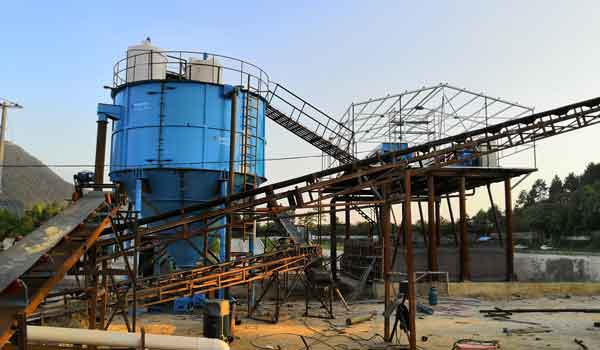
How to Manage the Operation of the Sludge Gravity Thickening Process
Date: Dec. 10, 2021
The sludge thickener is primarily designed for sludge with a concentration of 1% or less, aiming to increase its solid content—i.e., the sludge concentration. After processing through the sludge thickener, the discharge concentration exceeds 3%. This facilitates subsequent mechanical dewatering, thereby enhancing operational efficiency and optimizing the performance of mechanical dewatering equipment. How should sludge gravity thickeners be managed? Many customers seek clarity on this issue. This article provides a detailed analysis. 1. Scum in the thickening tank must be removed promptly. Use the scum scraper to transfer the scum into the scum collection tank for disposal. In the absence of a scum scraper, a water flushing method can be employed to wash the scum toward the edge of the pool for removal. 2. When mixing and concentrating primary sedimentation tank sludge with activated sludge, ensure uniform blending of the two sludge types. Prevent uneven entry into the thickening tank, as density-driven flows can disturb the sludge layer and compromise thickening efficiency. 3. If the thickening tank has not been discharged for an extended period, it must be emptied first; do not start the directly. 4. In northern regions with harsh winters, small concentration tanks in some sewage treatment plants are prone to freezing. Break any ice before starting the equipment. It is best to keep the mud scraping bridge running continuously to prevent freezing. 5. Regularly check whether the supernatant overflow weir effluent is uniform. If unevenness is detected, adjust promptly to prevent short-circuiting within the flow pattern of the thickening tank. 6. The thickening tank is a treatment facility with significant odor issues, and its surface is constantly exposed to odorous and corrosive gases. Frequently inspect equipment for…
Date: Dec. 10, 2021
The vibrating screen motor is a distinct component, separate from the screen body and other parts. If damaged, it cannot be replaced immediately, which will impact the operating efficiency of the vibrating screen. Therefore, mastering the maintenance and repair of the vibrating screen motor is essential. 1. Maintenance of Vibrating Screen Motor To ensure normal operation and extend the service life of the vibrating screen motor, daily maintenance is essential. The more diligent the routine upkeep, the greater its effectiveness. This forms the foundation for maintaining stable performance in vibrating screen motors. 1) Ensure Proper Axial Clearance in Vibration Motor Bearings After high-speed operation, bearings heat up and expand. Maintaining appropriate axial clearance ensures that bearings function correctly after thermal expansion, preventing motor burnout. 2) Correct Adjustment of Eccentric Blocks Since production volumes often fluctuate significantly over time, the excitation force of the vibration motor can typically be adjusted by changing the angle of the eccentric blocks. When doing so, pay close attention to the inner eccentric block’s axial position. The included angles between the outer eccentric blocks at both ends and the inner eccentric block must remain identical; otherwise, incorrect excitation forces may result, potentially damaging the vibrating screen.…
Date: Dec. 03, 2021
How to Quickly Deploy Small-Scale Sand Washing and Sewage Treatment Equipment? To enable rapid relocation of mobile sand washing and sewage treatment equipment, Longzhong Heavy Industry’s engineering team has meticulously calculated and developed a new structural design. The unit features enhanced stability, more reliable operation, faster transition times, and smarter automation—engineered specifically for cross-regional sewage treatment applications. 1. High Level of Intelligence The standalone unit offers advanced intelligence through a PLC control system integrated with a touch screen interface, increasing safety factors while simplifying operations for greater convenience. 2. Self-Contained Production Line Reduces Cost Investment A single self-contained production line can handle feeding, sewage treatment, screening, and material transport. This eliminates the need for foundation construction or material relocation, significantly reducing your overall cost investment. 3. Rational and Reliable Structure The entire machine features a ship-shaped steel frame structure to enhance body stability. Its streamlined design reduces air resistance, while the folding configuration minimizes footprint, making it ideal for various narrow and complex operating environments. 4. Built-in Diesel Motor with Dual Power Options The unit is equipped with an integrated diesel motor that allows one-key switching between oil and electric power. This ensures uninterrupted sewage treatment operations even in areas…
Date: Nov. 25, 2021
To ensure the high-frequency dewatering screen operates normally, it is essential to first follow the product's instructions for use. Additionally, specific preparations and precautions are required before startup, along with daily maintenance practices to minimize the risk of equipment failure. 1. Key Considerations When Operating a High-Frequency Dewatering Screen (1) Monitor bearing lubrication during vibration motor operation. Under normal working conditions, after approximately 1,600 hours of cumulative operation, replace the bearing grease and clean the bearings, bearing housings, and gland seals. (2) If the unit has been shut down or stored for more than six months, disassemble the motor for maintenance and replace the grease. (3) Once the accumulated operating time exceeds 5,000 hours, inspect the motor bearings. Replace them with new ones if any damage is detected. (4) After being idle for six months or longer, measure the insulation resistance between the motor stator windings and ground before restarting. When using a 500V megohmmeter, the insulation resistance must be no less than 20 MΩ. 2. Daily Maintenance of High-Frequency Dewatering Screen Before Startup (1) Inspect the coarse and fine mesh screens for any damage. (2) Ensure that all transport supports have been removed. During Operation (1) Monitor for any…
Date: Nov. 18, 2021
The High-Frequency Dewatering Screen is a key dewatering solution from Longzhong Heavy Industry. It is primarily applied in processes such as dry tailings disposal, concentrate dewatering, and slime separation. This equipment offers high processing capacity, effective dewatering performance, significant technical and economic benefits, and broad applicability across various industries. Working Principle of the High-Frequency Dewatering Screen 1. Unlike conventional belt-coupled drive systems, this high-frequency dewatering screen utilizes a specialized vibration exciter, ensuring a more stable and reliable motion trajectory. 2. When two motors rotate synchronously in opposite directions, the centrifugal forces generated by their eccentric blocks cancel out along the axis parallel to the motor shafts but add up along the axis perpendicular to them. This resultant force creates a linear screening trajectory. 3. The machine’s shafts are inclined at an angle relative to the vertical plane of the screen surface. Under the combined influence of the vibration force and gravity, materials on the screen move forward through continuous jumping motions. 4. As the material contacts the screen surface, particles and water smaller than the mesh openings pass through to achieve dewatering, desliming, and separation. Advantages of High-Frequency Dewatering Screens Unlike traditional dewatering screens, the high-frequency dewatering screens manufactured by…
We are here for your questions anytime 24/7, welcome your consultation.
The latest sand washer price.
Installation and maintenance.
Screening
Sand Washing Machines
Sludge Treatment
Sand Recycling Machines
Address: Shuangyue Road, Changdai Town, Mengjin County, Luoyang, China
Email: export@lylzzg.com
Tel: +86-18736301510


 日本語
 Русский
 中文
 Español
 Français
 Português
 العربية
 Tiếng Việt
 Deutsch
 한국어
 Türkçe
 বাংলা
 हिन्दी
 Bahasa Melayu
 Kiswahili