
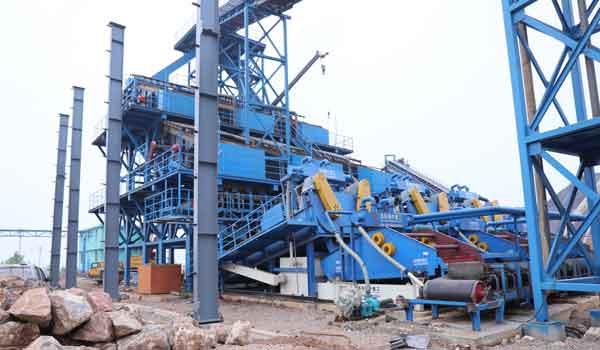
How to Produce High-Quality Machine-Made Sand
Date: Dec. 30, 2021
Natural sand and gravel resources are increasingly depleted, making it difficult to meet market demand. High-quality machine-made sand can satisfy the diverse requirements of various construction projects. So, how do you produce high-quality machine-made sand? The process begins with key factors such as material selection, equipment configuration, production technology, and quality control. 1. Optimize Base Material Selection A wide variety of raw materials can be used for machine-made sand production, including granite, basalt, river pebbles, cobblestones, limestone, calcite, andesite, rhyolite, diorite, diabase, sandstone, tailings, slag, quartzite, and more. Artificial sand produced from different rock types varies in strength and particle size, resulting in distinct applications and end-user requirements. 2. Machine-Made Sand Production Process The basic production process typically involves the following stages: raw stone blocks → coarse crushing → medium crushing → fine crushing → screening → dust removal → machine-made sand. In wet processing, a sand washer is used to remove stone powder. The primary equipment includes wheel and spiral sand washers. Since wheel-type sand washers result in lower loss of fine sand and stone powder, the produced sand exhibits better particle gradation. 3. Particle Gradation Control The shape of machine-made sand is primarily influenced by factors such as the development of lithological joints in the parent rock, the type of crushing equipment, and the screen configuration. The lithology of the parent rock affects the fracture surfaces during crushing and the degree of comminution. Impact crushers generally offer superior shaping effects and better control over particle morphology. Particle gradation of machine-made sand can be optimized by adjusting feed gradation, feed volume, crusher speed, screen mesh size, and other parameters. 4. Stone Powder Content Control A lower fineness modulus in…
Date: Dec. 24, 2021
The bucket stone washing machine is a new type of developed in recent years. Designed for washing sand and stones, it offers versatile applications and meets significant market demand. This article provides an overview of the bucket wheel stone washing machine. 1. Introduction to Wheel Bucket Stone Washing Machines The sand washing machine is an internationally advanced piece of equipment for washing sand and slag particles, introduced by our company through the adoption of foreign advanced technology from similar products. The bucket sand washing machine (stone washing machine) is a high-efficiency sand washing solution developed using advanced technology and tailored to the actual conditions of the domestic sand and gravel industry. It features a greater washing height, a rational structure, high output capacity, and minimal sand loss during the washing process. Notably, its transmission components are isolated from water and sand, resulting in a significantly lower failure rate compared to commonly used sand washing machines currently on the market. This makes it the ideal choice for upgrading operations in the sand washing industry. Bucket-type stone washing machines (machine-made sand washing units) are available in double-wheel and single-wheel configurations. While they share the same working principles and characteristics, the double-wheel model…
Date: Dec. 24, 2021
Silica sand products are pure and uniform in particle size, with no visible soil impurities. However, since raw silica sand ore is mined from mountains, it often contains significant amounts of mud. Therefore, thorough cleaning and impurity removal are essential. How to clean silica sand? 1. Common methods for removing soil and impurities include high-pressure water flushing and acid pickling. Silica sand manufacturers typically use high-pressure water guns to target larger material pieces, effectively washing away adhering soil. Acid pickling is employed to remove surface metal impurities such as iron and aluminum. The pickling process involves soaking the material in 6mol/L hydrochloric acid for 2 hours, or heating and soaking in concentrated hydrochloric acid for 30 minutes, followed by filtration, washing with water until neutral, and drying. 2. A significant amount of fine powder is also generated during the silica sand production process, which can compromise the purity of the final silica sand products. This stage necessitates ore washing. Typically, operators select specialized ore washing equipment, such as tumbling scrubbers. For filtration purposes, some facilities employ ultrasonic cleaning systems to purify the silica sand. How to Remove Impurities from Silica Sand? As widely known, silica sand is a quartz particle…
Date: Dec. 17, 2021
The linear vibrating screen utilizes a horizontal vibration motor. Adjusting the excitation force is relatively complex, and methods vary slightly depending on the specific type of vibration motor. The detailed procedure for adjusting the excitation force of this linear vibrating screen is outlined below. 1. When the Excitation Force is Below 30% or 50% 1) Loosen the fastening bolts securing the vibration motor shields and remove the shields from both ends. 2) On this type of vibration motor, the outer eccentric block is adjustable. The scale markings on its surface indicate the percentage relative to the maximum excitation force. The inner eccentric block is fixed and secured to the motor coupling using fastening bolts. Datum lines are engraved on both ends of the rotating shaft. 3) Tighten the compression bolts on the outer eccentric blocks at both sides. Rotate the outer eccentric blocks in the same direction until the marking line on the shaft aligns with the corresponding excitation force scale marking on the outer eccentric block, thereby achieving the desired excitation force level. 4) Securely tighten the compression bolts of the outer eccentric blocks, reinstall the protective covers, and complete the excitation force adjustment. 2. When the excitation force…
Date: Dec. 17, 2021
Thickeners are essential equipment in mineral processing plants, widely used for dewatering, reagent removal, concentration, and other critical operations. Low operational efficiency of thickeners is a common concern for many customers. This article provides a brief analysis of how to enhance thickener working efficiency. Improving the sedimentation performance of thickeners is key to boosting their productivity. Below, we discuss five aspects to optimize thickening efficiency. 1. Use flocculants to enhance concentration efficiency Ore particle sizes in slurry vary, and sedimentation speed depends on particle size: finer particles settle more slowly. Some processes require fine grinding to achieve better separation indicators, making effective settling of fine materials critical for improving thickener precipitation efficiency. Flocculants address this challenge by promoting particle collision and floc formation, increasing volume and accelerating settling speed. Determining the stirring speed based on the timing of ore particle flocculation is critical. Initially, a moderate stirring speed should be maintained to ensure the flocculant dissolves fully and uniformly within the slurry. Once particle flocs begin to form, the stirring speed must be appropriately reduced to prevent high shear forces from damaging the newly formed flocs. It is recommended to dilute the flocculant to a concentration between 0.1‰ and 0.25‰.…
We are here for your questions anytime 24/7, welcome your consultation.
The latest sand washer price.
Installation and maintenance.
Screening
Sand Washing Machines
Sludge Treatment
Sand Recycling Machines
Address: Shuangyue Road, Changdai Town, Mengjin County, Luoyang, China
Email: export@lylzzg.com
Tel: +86-18736301510


 日本語
 Русский
 中文
 Español
 Français
 Português
 العربية
 Tiếng Việt
 Deutsch
 한국어
 Türkçe
 বাংলা
 हिन्दी
 Bahasa Melayu
 Kiswahili