
Date: Feb. 20, 2021
The technical and economic indicators of the trommel screening process are screening efficiency and productivity. The former is a quality index, while the latter is a quantitative index. There is a certain relationship between them, which is also influenced by many other factors that determine the results of the screening. The factors affecting the screening process can be roughly divided into three categories.
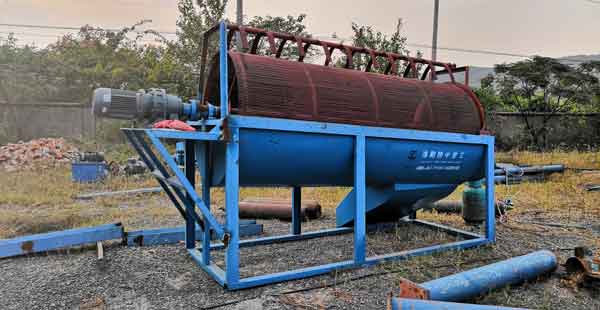
The particle size distribution, moisture content, clay content, and particle shape of the feed material significantly impact screening quality.
Higher feed rates generally increase sieve productivity. However, elevated moisture levels typically reduce screening efficiency; this negative effect diminishes as the aperture size increases. To optimize the screening process, it is common practice to enlarge the aperture size or employ wet screening methods. Materials with high clay content (exceeding 8%) should undergo pre-washing or wet screening.
Vibrating screens induce vertical movement between particles and the screen surface, resulting in high screening efficiency and large production capacity. In contrast, equipment where relative motion between particles and the screen surface is primarily parallel—such as reciprocating bar screens, planar vibrating screens, and cylindrical screens—typically offers lower screening efficiency and productivity.
For a specific material, the screen’s productivity and efficiency are determined by its dimensions. Productivity is directly related to the width of the screen surface; wider surfaces yield higher throughput. Screening efficiency depends on
The length of the screen surface is significant, with a typical aspect ratio of 2.
A larger effective screening area (defined as the ratio of mesh area to total screen area) results in higher productivity and screening efficiency per unit area.
Increasing the mesh size enhances both productivity per sieve surface and overall screening efficiency.
High screen loads generally lead to reduced screening efficiency. To a large extent, the flat rate of the screen depends on its size and the overall screening efficiency; larger screens typically offer higher productivity but lower screening efficiency. Uniform feed distribution is critical for optimal screening performance.
The inclination angle of the sieve should be appropriate and is usually determined through experimental testing. Additionally, the amplitude and vibration frequency of the sieve are closely related to its structural characteristics. Within a certain range, increasing vibration intensity can improve the screening index.
Please enter your inquiry and contact. We will reply you as soon as possible.
We are here for your questions anytime 24/7, welcome your consultation.
The latest sand washer price.
Installation and maintenance.
Screening
Sand Washing Machines
Sludge Treatment
Sand Recycling Machines
Address: Shuangyue Road, Changdai Town, Mengjin County, Luoyang, China
Email: export@lylzzg.com
Tel: +86-18736301510


 日本語
日本語 Русский
 中文
中文 Español
 Français
 Português
 العربية
 Tiếng Việt
 Deutsch
 한국어
한국어 Türkçe
 বাংলা
বাংলা हिन्दी
 Bahasa Melayu
 Kiswahili