
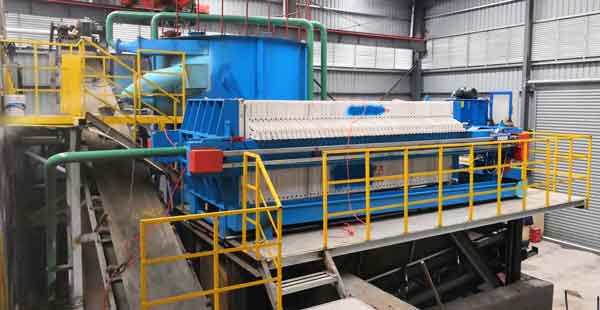
Do You Encounter These 8 Failures When Using a Filter Press?
Date: Dec. 14, 2020
Filter press is a commonly used solid-liquid separation equipment. Various failures will occur during the production process. This article introduces the failures and countermeasures of the filter press. 1. Damage to the frame itself Excessively thick mud or residual dry blocks can cause blockage at the feed port. When there is no material between the filter plates, only the pressure from the hydraulic system acts on them, making the plates highly susceptible to damage due to prolonged stress. Insufficient feeding or the presence of inappropriate solid particles in the feed can also result in excessive force or structural damage to the frame. If the discharge outlet is blocked by solids, or if the feed valve or discharge valve is closed during startup, pressure cannot be released, potentially leading to severe damage. Inadequate cleaning of the filter plate may cause medium leakage. Once leakage occurs, the edges of the plate frame are prone to developing small grooves from impact. Significant medium leakage prevents pressure buildup, thereby hindering the formation of mud cakes. Treatment method: Carefully use a nylon cleaning scraper to remove mud from the feed inlet. After completing this cycle, reduce the volume of the filter plate. Thoroughly inspect the filter cloth for any issues. Next, verify that the drain outlet is clear and unobstructed; open the corresponding pressure valve to release pressure. Finally, carefully clean and repair the filter plate. 2. Water seepage between plates and frames Low hydraulic pressure. Wrinkles or gaps in the filter cloth. If these occur, replace the filter cloth immediately. Unknown objects resembling blockages on the sealing surface. Treatment method: Increase hydraulic pressure accordingly, change the filter cloth, or use a nylon scraper to…
Date: Dec. 09, 2020
The sludge sewage treatment equipment in the sand washing sector typically employs filter presses and thickening tanks. As a widely adopted solution for sludge management, filter presses efficiently separate various types of high-moisture sludge, facilitating easier storage and transportation while effectively addressing the low efficiency associated with traditional sedimentation-based methods. What key considerations should be noted when selecting sludge and sewage treatment equipment for sand washing operations? 1. Pressure Control Pressure control is the primary factor influencing the filtration efficiency of a filter press. As widely recognized, the core operating principle of a filter press relies on precise pressure regulation to achieve effective separation. Consequently, the condition of the pressure system is critical; its operational status directly determines the quality of the filtration outcome. 2. Filtration Speed Filtration speed is the second key factor affecting the performance of a filter press. Many manufacturers currently prioritize high filtration rates without considering the fundamental requirements of the process. The optimal filtration speed must be tailored to the concentration of the slurry or liquid being processed. Factors such as resistance and flow dynamics should be carefully evaluated to ensure the filter press operates at an appropriately calibrated speed for maximum efficiency. 3. Filter…
Date: Dec. 07, 2020
The sand screening machine is a and gravel separation equipment suitable for rivers and coal yards. It is composed of a fuel tank, drum screen, reducer, conveyor belt, electric motor, and so on. The structure is simple, economical, and easy to operate. It is mainly divided into two types: drum sand screening machine and vibrating sand screening machine. There are four types of drum screening machines: 20, 30, 50, and 80. These models are divided into standard version and heavy version, and can also be customized according to the actual needs of customers. Due to the large output, the vibrating screen sand machine usually has three types: 30, 50, and 80. This kind of sand screen machine is equipped with up to four layers of screens, which can achieve multi-stage screening effects at the same time, and the price is also more expensive than the drum screen sand machine. 1. Different appearance The shape of the vibrating screen sand machine is rectangular, and it adopts a unique pressing net structure design, which will not mix the materials, and the screening accuracy is adjustable. The main structure of the drum sand screening machine is a sieve cylinder, composed of several circular…
Date: Dec. 02, 2020
In Sri Lanka, based on the principles of fracture mechanics, the vibrating screen frame undergoes shaking that induces bending fatigue during operation. This makes the screen frame and side plates susceptible to local deformation or cracking. The primary causes of vibration failure in vibrating screens during use are as follows. 1. Damping Spring Failure After prolonged service, springs may suffer permanent deformation due to rubber aging or sustained stress, leading to functional failure. This results in uneven fulcrum heights across the four sets of vibration-damping spring seats on the vibrating screen body. Consequently, amplitude inconsistencies arise throughout various parts of the vibrating screen, causing linked vibrations at specific locations or cracks in the welds of connecting components. Solution: Inspect the damping springs regularly. The spring material is typically 60Si2MnA, and its heat-treated hardness should reach HRC45–50. 2. Incorrect Eccentric Wheel Weight of the Exciter Improper eccentric weight can also lead to unbalanced vibration amplitude in the screen. If the weight is increased excessively, the amplitude may exceed the allowable limit, causing vibrations in the linkage components or cracking at welded joints. Solution: Set the eccentric weight strictly according to the manufacturer’s specifications for the vibrating screen and perform regular checks.…
Date: Nov. 30, 2020
Screening equipment is a critical auxiliary component in the mining, construction materials, chemical, and other industrial sectors. Its performance directly impacts production capacity as well as technical and economic indicators. Therefore, it is essential to understand common fault diagnosis and solutions for vibrating screens in practical production settings. This article outlines typical issues associated with vibrating screen exciters. The exciter serves as the vibration source for the screen body. Amplitude can be adjusted via counterweights. During operation, the centrifugal force generated by the eccentric mass acts as the exciting force. When dual-axis vibration exciters rotate synchronously, the screen box undergoes reciprocating linear vibration, allowing materials to pass through the gaps in the screening surface to complete the product separation process. 1. Starting Under Heavy Load Sudden shutdowns caused by production interruptions or failures in other equipment often result in the screen box becoming filled with minerals. Restarting the exciter under such heavy load conditions significantly increases the risk of damage to universal couplings and other exciter components. Solution: Avoid restarting the vibrating screen under heavy load. 2. Damping system damage If the damping spring fails or excessive material accumulates beneath the screen, the damping system may become uncoordinated, leading to…
We are here for your questions anytime 24/7, welcome your consultation.
The latest sand washer price.
Installation and maintenance.
Screening
Sand Washing Machines
Sludge Treatment
Sand Recycling Machines
Address: Shuangyue Road, Changdai Town, Mengjin County, Luoyang, China
Email: export@lylzzg.com
Tel: +86-18736301510


 日本語
 Русский
 中文
 Español
 Français
 Português
 العربية
 Tiếng Việt
 Deutsch
 한국어
 Türkçe
 বাংলা
 हिन्दी
 Bahasa Melayu
 Kiswahili