
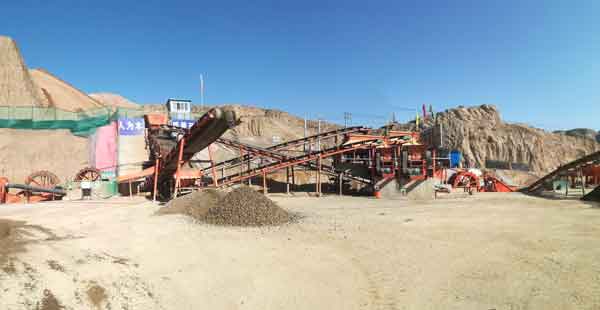
A Term Used In The Mining Sand Industry
Date: Feb. 24, 2021
Want to learn more about the mining industry? This article provides a glossary of common terms for your reference. 1. Silica Sand Silica sand, also known as silica or quartz sand, is a refractory particle primarily composed of quartz with a particle size ranging from 0.020mm to 3.350mm. Depending on the mining and processing methods employed, it is categorized into artificial silica sand and natural silica sand, such as washed sand, scrubbed sand, and selected (flotation) sand. 2. Aggregate Aggregate consists of granular loose materials, such as rock particles, that serve as skeletons in concrete, providing filling and volume stabilization. Based on particle size, aggregates are classified into coarse aggregate and fine aggregate. 3. Natural Sand Natural sand refers to rock particles with a nominal diameter of less than 5.00mm formed under natural conditions. According to their source of production, they can be divided into river sand, lake sand, sea sand, and mountain sand. 4. Artificial Sand Artificial sand comprises rock particles with a nominal diameter of less than 5.00mm, produced by excavating, mechanically crushing, and sieving rocks, pebbles, mine tailings, or industrial wastes. 5. Mixed Sand Mixed sand is composed of natural sand and artificial sand blended in specific proportions. 6. Crushed Stone Crushed stone refers to rock particles with a nominal particle size greater than 5.00mm, obtained through the crushing and screening of natural rocks or pebbles. 7. Flaky Particles in Artificial Sand The smallest one-dimensional dimension of artificial sand particles with a particle size of 1.18mm or larger is less than 0.45 times the average particle size of the corresponding fraction. 8. Fineness Modulus An index used to measure the coarseness or fineness of sand. 9. Dust…
Date: Feb. 20, 2021
The technical and economic indicators of the trommel screening process are screening efficiency and productivity. The former is a quality index, while the latter is a quantitative index. There is a certain relationship between them, which is also influenced by many other factors that determine the results of the screening. The factors affecting the screening process can be roughly divided into three categories. 1. Physical Properties of Screened Materials The particle size distribution, moisture content, clay content, and particle shape of the feed material significantly impact screening quality. Higher feed rates generally increase sieve productivity. However, elevated moisture levels typically reduce screening efficiency; this negative effect diminishes as the aperture size increases. To optimize the screening process, it is common practice to enlarge the aperture size or employ wet screening methods. Materials with high clay content (exceeding 8%) should undergo pre-washing or wet screening. 2. Structural Parameters of the Screen Surface Vibrating screens induce vertical movement between particles and the screen surface, resulting in high screening efficiency and large production capacity. In contrast, equipment where relative motion between particles and the screen surface is primarily parallel—such as reciprocating bar screens, planar vibrating screens, and cylindrical screens—typically offers lower screening efficiency…
Date: Feb. 11, 2021
The river sand washing machine is an indispensable piece of equipment in the sand and gravel industry. River sand washing plant machines are widely utilized across South Africa. However, driven by environmental protection standards and green energy-saving initiatives, river sand washing plants serve as the primary equipment for fine sand recovery—a critical step in the sand washing process that inevitably impacts the surrounding environment. Addressing these challenges, this article provides a comprehensive analysis to help customers determine whether investing in river sand washing machinery is a worthwhile venture in the South African market. 1. Introduction to River Sand Washing Machines The river sand washing plant is designed for cleaning and screening sand and gravel, serving as essential production equipment in the aggregates industry. It is widely applied across sectors including sand and gravel processing, building materials, mining, and concrete mixing plants. Common types of sand washing machines include bucket wheel washers, spiral washers, three-in-one washing systems, and drum washers. Different models offer varying washing efficiencies, feed particle sizes, and application scopes. Users should select sand washing equipment based on their specific operational requirements. 2. Investment Outlook for River Sand Washing Plants Driven by global urbanization and infrastructure development, market demand…
Date: Jan. 28, 2021
The stone sand washing machine is a critical component of the sand making plant in Singapore. Neglecting key factors related to this equipment can lead to issues such as low sand washing quality and poor performance, ultimately impacting productivity and economic benefits. 1. Site Selection for Stone Sand Washing Machines The installation site of a stone sand washer is critical. When installing a stone sand washing machine, you need not only sufficient ground space but also an adequate water supply to ensure the equipment operates effectively. This is because long-term use requires a stable foundation; an unstable base can negatively impact the working efficiency of the stone sand washer, leading to inconsistent performance in markets such as Singapore. 2. Material Handling for Stone Sand Washing Machines As sand washing equipment designed to clean sand and gravel materials, the presence of hard or corrosive substances in the feedstock can hinder the cleaning process for standard materials and cause excessive wear on the stone sand washing machine, thereby reducing the service life of the sand washer. Therefore, it is essential to strictly control the feeding conditions, screen the materials beforehand, and regularly clean the relevant components of the stone sand washing machine.…
Date: Jan. 25, 2021
In sand and gravel production, do you frequently experience ruptures or perforations in the circular motion vibrating screen? If you want to resolve this issue but are unsure how to proceed, replacing the screen with a new one is often the only option. This approach increases operational costs for users. Today, we will provide some effective solutions to these common problems. Structure of the Circular Motion Vibrating Screen The round vibrating sieve consists of nine key components: frame, left screen frame, right screen frame, polyurethane support beams, screen mesh, upper ore powder collection bucket, lower ore powder collection bucket, vibration motor, and electrical control panel. The screen mesh is mounted on the support beams, with one layer installed across the upper, middle, and lower beams respectively. These support beams engage with reinforcing ribs on the screen to provide structural stability. Working Principle of the Circular Motion Vibrating Screen The circular vibrating sieve utilizes an internal eccentric shaft as the excitation source. The motor drives the rotation of the eccentric shaft, causing the vibrating screen to follow a circular trajectory—moving up, forward, down, and backward. This motion ensures that materials are screened evenly and efficiently through the mesh. Common Causes…
We are here for your questions anytime 24/7, welcome your consultation.
The latest sand washer price.
Installation and maintenance.
Screening
Sand Washing Machines
Sludge Treatment
Sand Recycling Machines
Address: Shuangyue Road, Changdai Town, Mengjin County, Luoyang, China
Email: export@lylzzg.com
Tel: +86-18736301510


 日本語
 Русский
 中文
 Español
 Français
 Português
 العربية
 Tiếng Việt
 Deutsch
 한국어
 Türkçe
 বাংলা
 हिन्दी
 Bahasa Melayu
 Kiswahili