
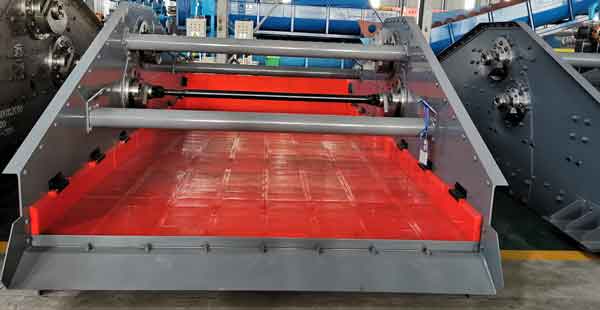
Advantages of Dewatering Screen Panels in China
Date: Apr. 29, 2021
In the vibrating screen industry, selecting the right dewatering screen panels is critical. The type of panel used significantly impacts production functionality and efficiency. Commonly used dewatering screen panels in vibrating screens are categorized into metallic and non-metallic types. Metallic screens are typically manufactured from low-carbon steel, high-carbon steel, spring steel, stainless steel, and similar materials, while non-metallic screens are primarily made from rubber, nylon, polyurethane, and other polymers. Within the LZZG range of vibrating screen products, with the exception of certain circular vibrating screens designed for grading large-particle materials, all other vibrating dewatering screens and tailings dry discharge screens utilize wear-resistant polyurethane screens featuring a high open area ratio. These screens offer excellent water permeability, extended service life, superior operational performance, and easy replacement. Compared to metallic screens, the polymer polyurethane dewatering screen panel material employed by Longzhong offers the following advantages. 1. It significantly enhances screening efficiency. By using polyurethane dewatering screen panels instead of metal screens, the equipment's screening efficiency can be increased by approximately 20%. 2. During maintenance and replacement, it effectively reduces installation time and improves equipment uptime. Due to the extended service life of polyurethane dewatering screen panels, screen surface replacements are significantly less frequent over the equipment lifecycle compared to other vibrating screen types. This results in an approximate 15% increase in operation rate compared to vibrating screens with metal screen surfaces. 3. The polymer polyurethane dewatering screen panel offers excellent wear resistance and a long service life. 4. Utilizing polymer polyurethane dewatering screen panels effectively reduces noise and improves the working environment. Beyond the resonance between metal screens and the screen box during operation, the mesh itself generates vibrations—a phenomenon that becomes…
Date: Apr. 20, 2021
The extensive development of mining in the past has led to significant resource waste and severe environmental pollution. In response to regional policies promoting green building materials, environmental protection, energy conservation, and reduced consumption, the fine sand recycling machine is widely advocated by the mining industry to maximize resource utilization. As a representative of screening equipment that combines energy efficiency with environmental friendliness, this offers distinct advantages such as lightweight design, large capacity, and low energy consumption, which are detailed below. 1. Continuous operation for high-efficiency screening, superior energy application rates, and robust screening capabilities. 2. Hydraulic opening and installation facilitate convenient maintenance and reduce downtime for replacing wear parts. The laminating and crushing process creates squeezing and friction between materials, enhancing grinding efficiency while minimizing the consumption of vulnerable components. 3. Thin oil lubrication ensures higher transmission efficiency, faster heat dissipation from main components, and greater durability during use. 4. In traditional wet processing of artificial sand, spiral sand washers used for washing and dewatering often struggle to control fine sand loss. Implementing this fine sand recovery system effectively reduces fine sand loss to within 5%–10%, addressing issues such as high fineness modulus in finished sand and low stone…
Date: Apr. 15, 2021
To address the challenges of processing raw ore mined from underground operations and discarding large volumes of tailings, the kaolin sand washing production line designed by LZZG not only resolves issues related to goaf filling, storage, and transportation of raw ore in beneficiation plants but also integrates functions such as material classification, washing, tailwater purification, and dry discharge of solid waste. This enables effective classification, sieving, cleaning, and dewatering of materials while conserving resources and reducing water consumption. Kaolin Introduction Kaolin is a non-metallic mineral, primarily consisting of clay and clay rock dominated by kaolinite clay minerals. Kaolin has a wide range of applications. It is mainly used in papermaking, ceramics, and refractory materials, followed by coatings, rubber fillers, enamel glazes, and white cement raw materials. A smaller portion is utilized in plastics, grinding wheels, soaps, pesticides, medicine, chemicals, building materials, national defense, and other industrial sectors. For soft kaolin and sandy kaolin, wet beneficiation processes are generally employed. Kaolin Production Line Process Slurrying: Water and dispersant are added to the raw ore according to specified concentration requirements, followed by mixing or mashing. The purpose of pulping is to disperse kaolin and separate it from sandy minerals and organic impurities,…
Date: Apr. 10, 2021
River pebbles are named for their cobblestone-like shape. They come in various shades, are hard and wear-resistant, and possess an aesthetically pleasing appearance. Highly favored by builders, they are widely used in residential construction, road building, bonsai cultivation, landscaping, and more. In recent years, beyond these traditional applications, the potential of river pebbles as a raw material for producing high-quality manufactured sand has been recognized. This discovery has further elevated the status of river pebbles in the construction sector, with manufactured sand derived from them meeting rigorous industry standards and earning strong endorsement from manufacturers. This article explores how to select the appropriate production equipment for a manufactured sand production line. The inherent advantages of river pebbles drive their popularity. However, selecting the right production equipment is critical to processing high-quality manufactured sand. Jaw Crusher The jaw crusher delivers superior crushing force and a high reduction ratio, serving as a core component of the production line. It also offers excellent abrasion resistance, resulting in lower maintenance costs. Additionally, this equipment is capable of processing a wide variety of materials. Cone Crusher The cone crusher is ideal for processing various medium-hard materials, particularly common sand-making inputs such as river pebbles, granite,…
Date: Apr. 02, 2021
A spiral sand washer is a common piece of sand washing equipment. This article outlines five frequent faults associated with spiral washing and their corresponding solutions, aiming to help you better understand the operation of spiral washers. 1. Broken Shaft The primary causes of shaft breakage include uneven sand return, insufficient strength of the hollow shaft, unbalanced running loads on the classifier, poor quality in shaft material processing, improper installation or bending of the hollow shaft, and incorrect operational procedures. These issues can be resolved by replacing the hollow shaft or performing re-welding repairs. 2. Abnormal Vibration or Noise If the spiral sand washing machine produces abnormal noise or vibrations during operation, immediately cease feeding materials. Once the remaining materials have been processed, shut down the generator and conduct a thorough inspection. Resume operations only after confirming that all systems are functioning correctly. 3. Damaged Spiral Blades or Bent Spokes This issue is typically caused by excessive sand return during operation, leading to blockages in the sand return tank, or insufficient spiral lifting prior to startup. The problem can be addressed by repairing or replacing the damaged spiral blades and spokes. 4. Gear Damage Prolonged wear can lead to gear…
We are here for your questions anytime 24/7, welcome your consultation.
The latest sand washer price.
Installation and maintenance.
Screening
Sand Washing Machines
Sludge Treatment
Sand Recycling Machines
Address: Shuangyue Road, Changdai Town, Mengjin County, Luoyang, China
Email: export@lylzzg.com
Tel: +86-18736301510


 日本語
 Русский
 中文
 Español
 Français
 Português
 العربية
 Tiếng Việt
 Deutsch
 한국어
 Türkçe
 বাংলা
 हिन्दी
 Bahasa Melayu
 Kiswahili