
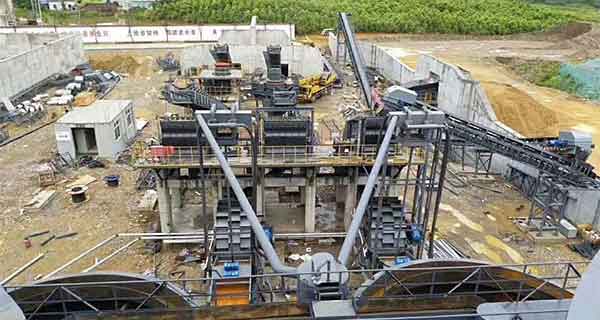
Quartz Silica Sand Purification Method
Date: Mar. 30, 2021
Quartz is a fundamental material in industrial production. Its most basic applications include use as a filter and absorbent, foundry sand, filler, or abrasive. In high-tech industries, quartz plays an extensive and critical role, particularly in the production of ultra-pure and high-value-added quartz products such as optical fibers and monocrystalline silicon. These materials are essential for the electronics industry and photovoltaic cells. Additionally, specialized experimental glassware used in synthesis and analytical chemistry represents another high-value category. Today, the quality of raw quartz sand is steadily declining. To meet industry demands, beneficiation processes are employed to enhance purity. The primary purification methods are outlined below. 1. Scrubbing Scrubbing utilizes mechanical force and inter-grain abrasion to remove thin-film iron, adhesives, and muddy impurity minerals from the surface of quartz sand. This process also breaks down unconsolidated mineral aggregates, allowing for further purification through grading. Currently, the main techniques include rod scrubbing and mechanical scrubbing. Key factors influencing scrubbing efficiency are the structural characteristics and configuration of the scrubber. Secondary factors include scrubbing duration and concentration (typically maintained at 50%–60%). 2. Magnetic Separation Magnetic separation is primarily used to eliminate magnetic minerals from quartz sand. For instance, weakly magnetic minerals such as hematite, limonite, and biotite can be removed using high-intensity magnetic separators, while strongly magnetic minerals like magnetite are effectively separated using low-intensity magnetic separators. 3. Flotation Flotation is employed to eliminate impurities that magnetic separation cannot remove, such as feldspar and mica in quartz sand, thereby further enhancing its purity. 4. Acid Leaching Acid leaching exploits the fact that quartz is insoluble in acid (except for hydrofluoric acid), while other impurity minerals can be dissolved in acid, enabling further purification of…
Date: Mar. 23, 2021
Introduction Wastewater generated during the production process of concrete batching plants contains not only conventional construction materials such as sand and cement but also concrete admixtures. Direct discharge would cause severe pollution to the natural environment. The sewage treatment plant designed and developed by Longding is a closed-loop, automated system. Based on recycling principles, it separates wastewater from mud and sand, achieves mud-water separation, and discharges solid waste in a dry state. Through processes including screening, washing, dewatering, recycling, solid-liquid separation, and sludge dewatering, the system effectively separates sludge from clean water. This ensures high recovery rates for screened sand and gravel, purifies and recycles sewage, conserves resources, reduces water consumption, and meets environmental protection standards, enabling concrete batching plants to achieve environmentally friendly production. Major Equipment The sewage treatment plant for concrete batching plants primarily includes sewage treatment pipelines, sewage tanks, clean water tanks, sediment separation equipment, screening equipment, fine sand recovery equipment, dryers, thickening tanks, filter presses, and other components. s. Screening equipment: A dewatering screen is used to remove moisture from sand and gravel, while a swing screen classifies the materials for raw material reuse. Fine sand recovery equipment: Integrated sand washing and recovery machines or dedicated…
Date: Mar. 13, 2021
In the sand washing industry, is an essential piece of equipment in any . During wet sand washing, fine and surface sand are inevitably lost with the wastewater flow, resulting in a loss of 5% to 25% per production line. Recovering these lost materials can significantly boost profitability. This article outlines four effective methods for recovery. Regardless of the type of , agitation during the washing process causes most sand particles to be carried away by the water, leading to unclear separation and inevitable material loss. Four Methods for Fine Sand Recovery 1. Implement a Multi-Stage Sedimentation Tank Sand washing wastewater flows into the sedimentation tank, which is preferably equipped with three layers to allow for gradual layer-by-layer settling over time. Due to the higher specific gravity of sand and mud, they can be effectively separated after prolonged precipitation. However, this method has notable drawbacks: the extended sedimentation process requires a large footprint for the tanks, and subsequent manual excavation of settled sand and mud is both time-consuming and labor-intensive. 2. Equipped with dewatering screen equipment Sand washing wastewater is discharged directly onto the surface of the linear dewatering screen to recover lost fine sand. The limitation of this approach…
Date: Mar. 10, 2021
A spiral sand washing machine, also known as a sand washer, is mechanical equipment designed for cleaning both artificial and natural sand. It delivers superior washing performance by removing surface impurities from sand and gravel, breaking the water film covering the particles, and achieving effective dehydration. Features of Spiral Sand Washing Machine 1. The spiral sand washing machine is a high-efficiency, energy-saving sand processing unit characterized by a stable structure, low power consumption, high cleanliness, excellent sealing, fully enclosed transmission device, durability, adjustable weir plates, and consistent product quality. Its operational efficiency is 50% higher than that of traditional sand making machines, making it ideal for abrasive manufacturing. 2. This machine offers broad application versatility, suitable for industries such as metallurgy, building materials, hydropower, and more. It effectively cleans, classifies, removes fines, and washes construction sand, road sand, and gravel sandstone. Precautions for Operating the Spiral Sand Washing Machine 1. Spiral sand washer manufacturers are responsible for installation, adjustment, and assembly. Products are only shipped after passing qualified empty-load testing. 2. Upon receiving the spiral sand washer, users should carefully inspect its appearance and structural integrity. If any damage occurred during transportation, contact the manufacturer immediately. 3. During installation, adjustment,…
Date: Mar. 05, 2021
The sand washing machine is a type of designed for processing both artificial and natural sand. Its primary function is to remove impurities from sand products, offering robust processing capacity and high cleanliness in mechanical sand production. As a key industrial equipment in domestic sand making operations, its efficiency can decline over time due to wear; therefore, regular maintenance is essential. To optimize the performance of the sand washing machine, the following measures should be implemented. 1. Focus on Proper Sand Washing Machine Installation Upon arrival of the sand washing machine, inspect all components for integrity and confirm the unit is in optimal condition before installation. Begin with a no-load test run. During this phase, technicians must continuously apply lubricating oil to the sand washer, checking for any loose connections or weak points. Proceed to a load test only after verifying stability during the no-run period. Ensure 8 to 12 hours of error-free operation under load before commencing official production. 2. Pre-Start Inspection Checklist Before starting the machine, clear any debris from the drain holes to prevent blockages. For stable performance and safe operation, install the sand washer on a solid concrete foundation strictly according to the design drawings. 3.…
We are here for your questions anytime 24/7, welcome your consultation.
The latest sand washer price.
Installation and maintenance.
Screening
Sand Washing Machines
Sludge Treatment
Sand Recycling Machines
Address: Shuangyue Road, Changdai Town, Mengjin County, Luoyang, China
Email: export@lylzzg.com
Tel: +86-18736301510


 日本語
 Русский
 中文
 Español
 Français
 Português
 العربية
 Tiếng Việt
 Deutsch
 한국어
 Türkçe
 বাংলা
 हिन्दी
 Bahasa Melayu
 Kiswahili