
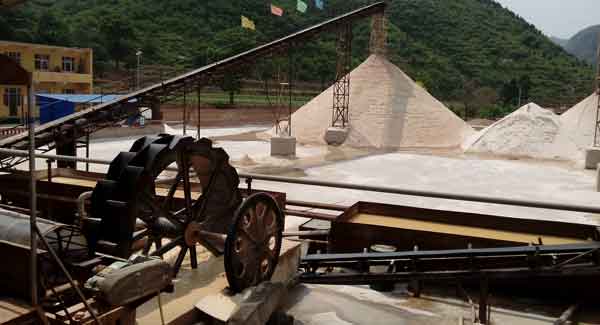
Take You To Know The Silica Sand Washing Process
Date: Jan. 19, 2021
The silica sand washing process is generally determined by three key factors: the occurrence state of impurity minerals in the raw sand, the beneficiation cost of the purification process, and the industrial applications of the refined sand products. During the weathering process, silica sand washing involves the sedimentation and mineralization of quartz sand, accompanied by a significant presence of clay minerals and iron originating from cementing or adherent minerals on the quartz surface. Scrubbing, grading, and desliming processes are employed to remove clay impurity minerals, argillaceous iron, and a portion of thin-film iron. The First Generally, common impurity minerals in quartz sand—such as limonite, tourmaline, hematite, biotite, and other weakly magnetic minerals, as well as magnetite and strongly magnetic minerals—can only be removed through magnetic separation. In actual production, wet-type high-intensity magnetic separators are commonly used for sorting, with a magnetic field strength of approximately 13,000 Oersteds. The Second After the quartz sand ore undergoes scrubbing, magnetic separation, and flotation, mineral particles (including both monomers and aggregates) with low levels of impurity occurrence have been largely removed. The purity of the silica typically reaches 99.5%–99.9%, which is sufficient for most industrial applications of quartz sand. However, in the silica sand washing process in Malaysia, if further refinement into ultra-high-purity quartz sand is required, acid leaching treatment must be applied to remove impurities that continuously form on the surface of quartz particles as spots and inclusions. Depending on specific industrial uses, differe nt impurity minerals (Fe, Al, Ti, Cr) requirements. Mixed acid leaching is performed using varying concentrations and proportions. Following the scrubbing-desliming-magnetic separation-flotation-acid leaching process, high-purity quartz sand with a silica content of 99.99% or higher is obtained. The Third…
Date: Jan. 11, 2021
The primary function of sand washing technology is to remove impurities from sand and aggregate products. In the production of manufactured sand, sand washers offer significant advantages, including high processing capacity and superior cleanliness. As mainstream equipment in the sand-making industry, their efficiency may decline over time with extended use. Below, we outline six key factors that affect the performance of sand washers, helping you better prevent efficiency losses and maintain optimal operation. 1. Improper Site Selection The installation location of is a critical factor requiring careful attention. When selecting the site for your sand washer, it is essential to ensure both a stable foundation and an adequate water supply to prevent operational instability. An unsuitable location can significantly compromise the performance of the sand washing machine. 2. Unqualified Feed Materials The quality of materials processed by demands strict attention. Introducing mixed hard or corrosive substances into the sand washer can negatively impact cleaning efficiency and reduce the equipment's service life. Therefore, regular maintenance of relevant components is necessary when feeding materials into the system. 3. Incorrect Installation Position Improper installation of the sand washer leads to reduced work efficiency in . Installing the unit on insufficiently firm ground causes…
Date: Jan. 04, 2021
As a resource-dependent sector within the building materials industry, the silica sand washing process is critical to the future development of the industry. Therefore, addressing environmental challenges is urgent. The silica sand washing process primarily generates pollution issues such as dust, noise, and wastewater; relevant discussions on these topics are essential to promote the green development of the machine-made sand industry. 1. Dust Control In The Silica Sand Washing Process In the silica sand washing process, dust control mainly involves two methods: dust suppression and dust removal. During the production of sand and gravel aggregates, dust is primarily categorized into organized dust and unorganized dust. Organized dust Organized dust is mainly generated during the silica sand washing, crushing, screening, and transportation processes. For the treatment of organized dust, dust suppression should be prioritized. Through optimized design, dust generation during production can be reduced, effectively lowering the subsequent dust treatment load, saving investment costs, and improving efficiency. At the connection between each process, select appropriate discharge pipes and inclination angles to minimize drop height at the discharge point and reduce impact on equipment. Belt conveyors should be enclosed to prevent dust leakage, and conveyor speeds should be properly controlled to minimize…
Date: Dec. 28, 2020
Silica sand mining aggregate is a general term for materials such as sand, pebble (gravel) stone, crushed stone, block stone, and aggregate in water conservancy and construction projects, serving as the primary building material for concrete and masonry structures. This article summarizes common questions regarding concrete aggregates. Question 1: What key factors should be monitored when receiving coarse and fine aggregates? For coarse aggregates, primary attention must be paid to particle size, gradation, grain shape, stone powder content, and mud content. Each delivery vehicle requires a preliminary visual inspection; unqualified loads must not be unloaded. Additionally, various indicators must be tested in batches in accordance with regulatory requirements. For fine aggregates, control must focus on fineness modulus and mud content. Each delivery vehicle requires a preliminary visual inspection; unqualified vehicles must not be unloaded. Batch testing must also be conducted according to specifications. Question 2: Why is it critical to limit the needle and flake content of coarse aggregates in pumped concrete? High needle-like content results in lower flexural strength of the individual particles and reduced bonding strength between aggregates, leading to decreased overall concrete strength. In ready-mixed concrete, excessive needle and flake content compromises aggregate shape, thereby reducing concrete…
Date: Dec. 21, 2020
During the operation of the belt conveyor, a sudden shutdown or operational failure can disrupt the entire production line and result in significant economic losses. Therefore, it is essential to master the correct installation and operating procedures. 1. Main Installation Sequence The main body should be installed in the following order: first the head pulley unit, then the intermediate frames for each section, and finally the tail pulley unit. Before installing the frames, the centerline of the conveyor must be established. All working centers along the conveyor’s length should align in a straight line. During the installation of each frame, ensure that the longitudinal centerline remains consistent across the conveying distance, and that the longitudinal horizontal tilt angle stays within the allowable tolerance range. The error range of the single-row rack relative to the centerline should be ±0.1mm, and the deviation of the conveyor from the center of the rack should be less than 35mm. Once the placement of all single-section racks has been verified as correct, all components can be connected. After connection is complete, check the firmness of the installation and the accuracy of the center position. 2. Installation of the drive unit Ensure that the drive shaft…
We are here for your questions anytime 24/7, welcome your consultation.
The latest sand washer price.
Installation and maintenance.
Screening
Sand Washing Machines
Sludge Treatment
Sand Recycling Machines
Address: Shuangyue Road, Changdai Town, Mengjin County, Luoyang, China
Email: export@lylzzg.com
Tel: +86-18736301510


 日本語
 Русский
 中文
 Español
 Français
 Português
 العربية
 Tiếng Việt
 Deutsch
 한국어
 Türkçe
 বাংলা
 हिन्दी
 Bahasa Melayu
 Kiswahili