
Date: Dec. 17, 2021
Thickeners are essential equipment in mineral processing plants, widely used for dewatering, reagent removal, concentration, and other critical operations. Low operational efficiency of thickeners is a common concern for many customers. This article provides a brief analysis of how to enhance thickener working efficiency.
Improving the sedimentation performance of thickeners is key to boosting their productivity. Below, we discuss five aspects to optimize thickening efficiency.
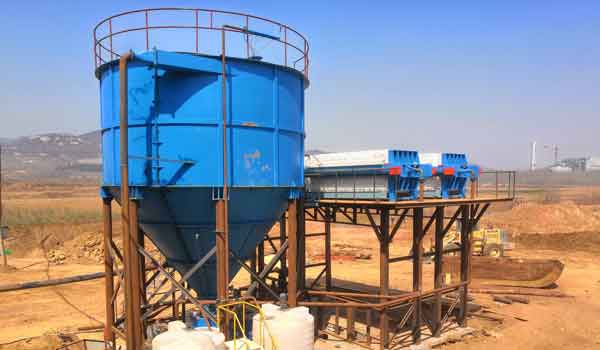
Ore particle sizes in slurry vary, and sedimentation speed depends on particle size: finer particles settle more slowly. Some processes require fine grinding to achieve better separation indicators, making effective settling of fine materials critical for improving thickener precipitation efficiency. Flocculants address this challenge by promoting particle collision and floc formation, increasing volume and accelerating settling speed.
Determining the stirring speed based on the timing of ore particle flocculation is critical. Initially, a moderate stirring speed should be maintained to ensure the flocculant dissolves fully and uniformly within the slurry. Once particle flocs begin to form, the stirring speed must be appropriately reduced to prevent high shear forces from damaging the newly formed flocs. It is recommended to dilute the flocculant to a concentration between 0.1‰ and 0.25‰. Utilize automated control systems to regulate the dosing rate, ensuring consistent administration and concentration. The selected reagent should accelerate the sedimentation rate while guaranteeing effective coagulation performance.
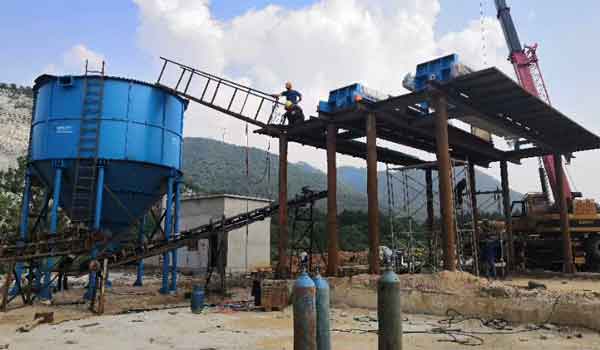
Before the pulp enters the thickener, it should pass through a degassing tank to eliminate bubbles within the pulp. This prevents mineral particles from adhering to bubbles, which can negatively impact settling efficiency. Typically, the degassing tank lifts bubbles to the liquid surface, allowing them to expand and burst, thereby releasing the gas. The design of the degassing tank must provide sufficient space for effective bubble removal. During installation, ensure that the upper edge of the overflow baffle in the degassing tank is as level as possible. This allows the slurry to flow evenly over the baffle in a thin film, facilitating gas escape.
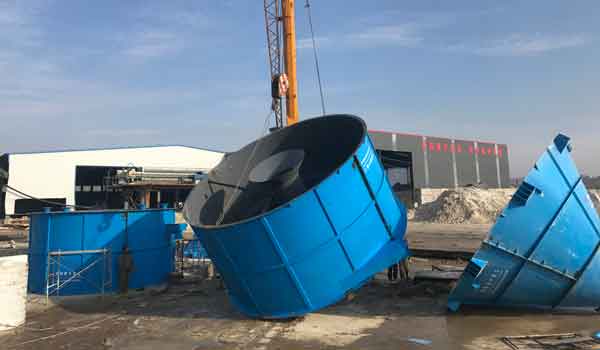
The slurry enters the sedimentation zone through the thickener’s central feed well. In terms of feed port design, the inlet is positioned lower to allow degassed slurry to enter directly at the liquid surface within the tank, preventing gas entrainment during feeding. This ensures that no air bubbles are introduced into the ore slurry. Additionally, a feed pan can be installed in the feed sleeve to maintain uniform and stable feeding. This prevents the incoming slurry from disturbing settled ore particles, thereby avoiding the “fluttering” phenomenon.
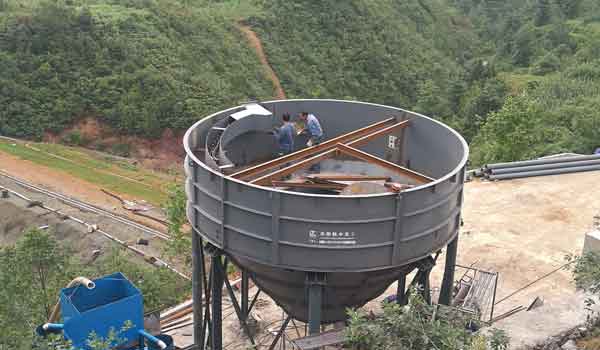
The bottom structure of the thickener also significantly influences sedimentation efficiency. Currently, rake-type thickeners are commonly used in concentrators, available in central drive and peripheral drive configurations. The primary factor affecting the thickener’s sedimentation efficiency is the slope angle of its bottom.
To discharge the sedimentary ore slurry through the central discharge port located at the pool bottom, the thickener features a conical base design. A rake scraper continuously moves the sludge toward this central discharge port. The steep inclination of the bottom cone ensures relatively effective concentration performance.
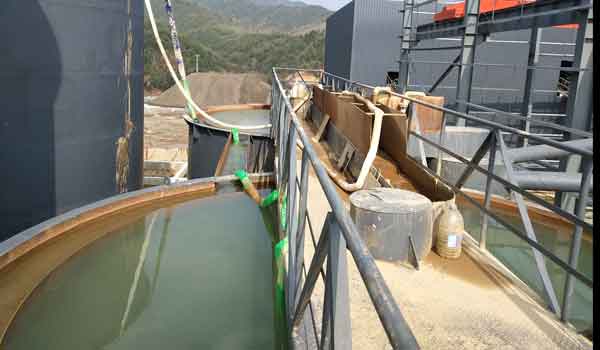
The thickener’s automatic control system integrates devices for chemical dosing, rake lifting, and underflow pumping. This system monitors variations between slurry layers within the thickener, enabling precise operational control to enhance settling efficiency.
The above discussion outlines methods to improve specific aspects of thickening performance. We hope this information benefits mining operators. For actual production scenarios, consult a qualified thickener manufacturer to select equipment tailored to your operational and economic requirements, thereby optimizing production capacity.
Please enter your inquiry and contact. We will reply you as soon as possible.
We are here for your questions anytime 24/7, welcome your consultation.
The latest sand washer price.
Installation and maintenance.
Screening
Sand Washing Machines
Sludge Treatment
Sand Recycling Machines
Address: Shuangyue Road, Changdai Town, Mengjin County, Luoyang, China
Email: export@lylzzg.com
Tel: +86-18736301510


 日本語
日本語 Русский
 中文
中文 Español
 Français
 Português
 العربية
 Tiếng Việt
 Deutsch
 한국어
한국어 Türkçe
 বাংলা
বাংলা हिन्दी
 Bahasa Melayu
 Kiswahili