
In silica sand production, in addition to standard product quality control measures, design-level controls for the production line must also be considered. This article primarily addresses controlling needle-flake content in finished materials, managing stone powder content, and regulating moisture levels in fine aggregates.
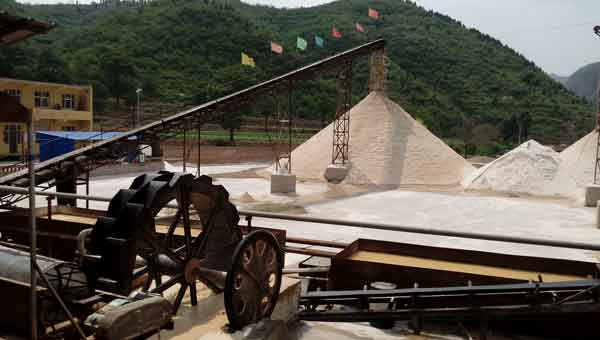
According to standards for concrete coarse aggregate, the needle-flake content should be less than 15%. Key control measures include using advanced crushing equipment and implementing reasonable process flows.
In silica sand production, jaw crushers are typically selected for coarse crushing, though some users opt for gyratory crushers. Medium and fine crushing generally employ impact or cone crushers. Equipment selection depends on material hardness. Compared to other options, impact crushers produce final aggregates with lower needle-flake content and superior particle shape.
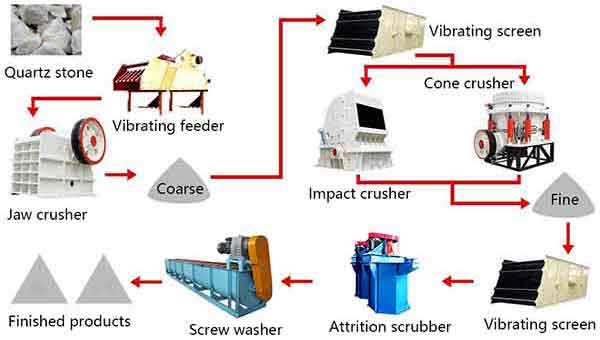
Studies have demonstrated that in silica sand production, appropriately increasing the stone powder content enhances concrete mix performance and improves its comprehensive mechanical properties. To achieve this, the following measures can be implemented during the process design of the sand and gravel production line.
1. The sieved sand-water mixture passes through a grit chamber before entering the spiral sand washer. Selecting a wide-weir, long-spiral classifier increases the settling area length, thereby reducing stone powder loss while simultaneously improving dehydration efficiency.
2. The ultra-fine crushing workshop is designed for dry sand making. Inspect the screening workshop to ensure effective dry screening, maintaining optimal stone powder content in the final product.
3. Regularly monitor the stone powder content in the sand and make timely adjustments to the process parameters and stone powder mixing ratios.

According to relevant regulations, the moisture content of manufactured sand should be less than 6%, with a fluctuation range of less than 2%. Therefore, in process design, partitioned storage and access are adopted when increasing production capacity and extending the sand-making table. Additionally, pre-dewatering and natural dewatering methods are employed.
1. Increase sand production capacity to ensure adequate storage volume and sufficient dehydration time.
2. Pre-dewatering involves installing a pre-dewatering screen at the discharge end of the belt conveyor leading to the finished sand stockpile. Qualified sand is screened, discharged onto the belt conveyor via a spiral sand washer, and then transported by the belt conveyor to the pre-dewatering screen.
3. The designed sand storage area provides sufficient stockpile capacity to extend the duration of storage and dewatering. Test results indicate that with a stone powder content of 14.8% and an initial moisture content of 17.96%, the sand moisture content decreases to 5.8% after 153 hours of storage. Similarly, when the stone powder content is 17.95% and the initial moisture content is 16.59%, the moisture level drops to 5.93% after 186 hours of storage. A blind drain is installed at the bottom of the storage area, complemented by an external drainage ditch around the site to facilitate efficient water discharge.
4. Install a rainproof canopy over the top of the sand pile area and equip the sand conveyor belt with a protective rain cover.
5. Position a water collection pan and channel beneath the gallery discharge port in the sand pile area to intercept seepage water from outside the belt conveyor.
Implementing these measures ensures that the moisture content of the finished sand is maintained below 6%.
Please enter your inquiry and contact. We will reply you as soon as possible.
We are here for your questions anytime 24/7, welcome your consultation.
The latest sand washer price.
Installation and maintenance.
Screening
Sand Washing Machines
Sludge Treatment
Sand Recycling Machines
Address: Shuangyue Road, Changdai Town, Mengjin County, Luoyang, China
Email: export@lylzzg.com
Tel: +86-18736301510


 日本語
 Русский
 中文
 Español
 Français
 Português
 العربية
 Tiếng Việt
 Deutsch
 한국어
 Türkçe
 বাংলা
 हिन्दी
 Bahasa Melayu
 Kiswahili