
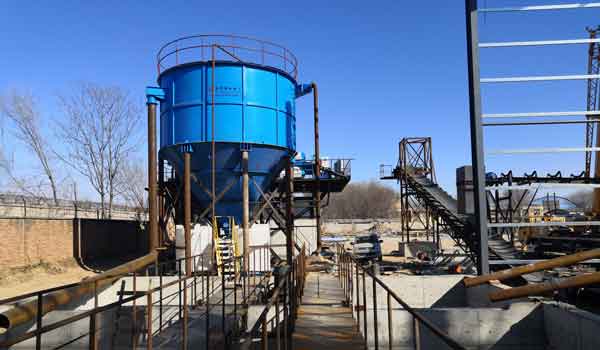
How to Solve Common Issues with Gravity Thickeners
Date: Jul. 14, 2021
The gravity thickener is primarily used for the dewatering of concentrates and tailings in mineral processing plants. In daily operations, rake pressure overload is one of the common failures encountered with gravity thickeners. Once this issue occurs, it not only wastes material resources but also increases investment costs. Therefore, timely resolution is critical. How can we address the rake pressure overload problem in gravity thickeners? Let’s explore the solutions below. There are many reasons for the crushing of the gravity thickener. Below we mainly introduce the failure and feeding of the gravity thickener. Causes pressure harrow of gravity thickener The main faults of the gravity thickener are the falling off of the rake teeth of the rake, the deformation of the rake, the falling off of the angle steel agitator, and the failure of the underflow pump. 1. The rake teeth of the gravity thickener rake fall off The material of the thickener is scraped from the upper part of the thickener to the bottom during the drive of the rake. If the rake frame (part of the rake frame) of the thickener rake is damaged or falls off, the material cannot be effectively scraped off during the rotation of the rake, causing the material to accumulate, and the harrowing failure is prone to occur. 2. The rake of the gravity thickener is deformed The deformation of the rake of a thickener is similar to the shedding of rake teeth. When the rake is bent and deformed, the rake teeth at the deformed part cannot scrape the material stably and effectively during the transmission process, which will cause the material to accumulate for a long time and cause the problem…
Date: Jul. 10, 2021
The fine sand recovery machine is a device capable of transforming stones into sand. It offers the advantages of stable discharge and precise particle size control. Consequently, as the market potential for manufactured sand continues to expand, demand for fine sand recycling machines is steadily increasing. This article focuses on href="https://www.lzzgasia.com/products/sand-recycling-machines"fine sand recovery equipment[[/U0]], providing detailed insights into its performance, pricing, and manufacturers to serve as a reference for your selection process. 1. Types of Fine Sand Recycling Machines Fine sand recycling machines come in various types and configurations. To meet the diverse needs of most users, manufacturers have integrated different technical concepts to launch a wide range of models, including seventh-generation, dewatering, and mobile units, each with varying output capacities and performance specifications. Key details are outlined below. 1) Seventh-Generation Fine Sand Recovery Machine Output: 70-585 t/h 2) Dewatering Type Fine Sand Recovery Machine Output: 60-320 t/h 3) Mobile Fine Sand Recovery Machine Output: 50-280 t/h 2. Advantages of Fine Sand Recycling Machines This equipment can be configured with any type or specification of fine sand recovery unit. A single machine functions equivalently to a small-scale sand washing production line. It requires no piling or complex installation, allowing for…
Date: Jul. 03, 2021
Dry tailings discharge is an emerging technology for tailings management that has gained traction globally. In this process, the tailings slurry undergoes multi-stage concentration before being processed by high-efficiency dehydration equipment, such as , to achieve low moisture content. The resulting material is easy to settle and solidify, allowing it to be transported to a designated area for dry storage. By tailoring the dry discharge process and selecting appropriate equipment based on specific factors—such as tailings type, particle size, concentration, and mud content—operators can minimize land footprint and reduce capital investment while ensuring effective dry discharge. Below, we outline five common dry tailings processing schemes to help you select the most suitable solution for your operation. 1. Cyclone-Thickener Scheme Beneficiation tailings with a concentration of 10%-20% are pumped via slurry pumps into cyclones. The cyclone overflow enters a thickener, where fine-grained particles are concentrated. The thickener overflow consists of clarified water, which is recycled back into the production cycle. The cyclone underflow and thickener underflow are combined, resulting in a final concentration of 45%-50%. The dry tailings process plan fully leverages the differences in particle size among tailings. By prioritizing the concentration of coarse particles, it enhances the thickener’s processing…
Date: Jul. 01, 2021
As a key piece of screening equipment in South Africa, the vibrating screen primarily utilizes its vibration characteristics to perform classification, dewatering, and desliming operations, making it widely applied in concentrator screening processes. In production practice, due to the complex operating environment, prolonged continuous operation, and heavy loads, the vibrating screen is inevitably subject to wear or even malfunction. To ensure reliable concentrator screening operations, daily maintenance and repair of the vibrating screen are essential, along with prompt emergency measures in case of failure. The following section outlines common operational issues and their solutions for vibrating screens. Problem 1: Poor Screening Efficiency Our range of vibrating screens primarily includes linear vibrating screens, high-frequency vibrating screens, and circular vibrating screens. The causes for suboptimal screening performance vary by equipment type. For circular vibrating screens, insufficient inclination of the screen surface is a primary factor leading to poor results. For linear and high-frequency vibrating screens, inadequate screening efficiency may stem from the movement direction of the eccentric blocks. If the two sets of eccentric blocks are not in phase, the direction of the exciting force will not align with the vibration direction, preventing efficient screening. Solution To address this issue, it is…
Date: Jun. 26, 2021
Sand washing wastewater refers to the effluent generated during the sand washing process in a sand washing plant. Sand and gravel are fundamental construction materials. With the rising demand for these aggregates, natural sand faces increasing pressure from resource depletion and environmental regulations. As a key source of construction sand, washed sand is entering the building materials market. What is sand washing sludge wastewater? The primary pollutants in sand washing wastewater are chemical oxygen demand (COD) and suspended solids. The content of suspended solids is high, with concentrations reaching approximately 3000mg/L, resulting in significant volumes of mud water. The characteristics of this mud depend on its composition and geological conditions. Generally, mud sewage appears earthy yellow, uniform, and viscous, without stratifying over long periods. If sludge wastewater is not treated promptly and effectively, it will not only waste substantial water resources, pollute water quality, affect road traffic, and disrupt the normal production and daily life of nearby residents, but may also intensify social conflicts and introduce disharmony into society. The environmentally friendly zero-emission process from LZZG LZZG has developed environmentally friendly zero-discharge equipment to address challenges in sand washing wastewater recycling and mud purification treatment. The zero-emission system primarily consists…
We are here for your questions anytime 24/7, welcome your consultation.
The latest sand washer price.
Installation and maintenance.
Screening
Sand Washing Machines
Sludge Treatment
Sand Recycling Machines
Address: Shuangyue Road, Changdai Town, Mengjin County, Luoyang, China
Email: export@lylzzg.com
Tel: +86-18736301510


 日本語
 Русский
 中文
 Español
 Français
 Português
 العربية
 Tiếng Việt
 Deutsch
 한국어
 Türkçe
 বাংলা
 हिन्दी
 Bahasa Melayu
 Kiswahili