
LZZG is a newcomer in mining machinery industry. After years of development, Our products cover all aspects of the equipment field in the sand washing industry, such as sand washer, dewatering screen, vibrating screen, paste thickener, filter press, etc., and have gained the consensus of the industry.
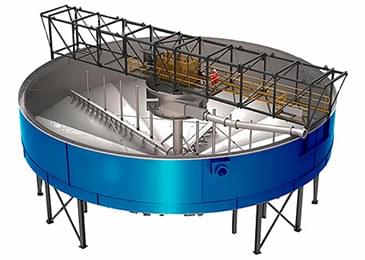
A gravity thickener is a solid-liquid separation device that operates on the principle of gravity settlement, functioning similarly to clarifiers and sedimentation tanks. It facilitates the gradual settling of suspended solids in slurry to the bottom of the tank. Gravity thickeners are widely employed in mining, metallurgy, and other industries for processing various minerals, metals, and non-metals. Additionally, they are utilized in industrial wastewater treatment, environmental protection, and related fields. Working Principle During operation, the slurry is mixed with flocculant and fed into the gravity thickener via the central cylinder. A guide plate at the outlet of the feed vertical cylinder directs the slurry from the center to the surrounding areas, allowing it to diffuse evenly. Through gravity settling, a gravity thickener can concentrate slurry with a solid content of 10%–20% into underflow slurry with a solid content of 45%–55%. Assisted by an internal rake mechanism, the thickened underflow slurry is discharged through the thickener’s underflow port. Meanwhile, the clarified water from the upper layer exits via the top drainage outlet, achieving effective mud-water separation. Features 1. High processing capacity per unit volume and superior concentration efficiency. 2. Hydraulic multi-point drive with infinite speed regulation, high mechanical strength, and built-in overload protection. 3. Equipped with a hydraulic rake lifting device for reliable operation.

The LSF hydraulic classifier is part of the family of classification equipment. It adopts the “layer flow high shear rate” mechanism, solving the problem where traditional technologies cannot adapt to changes in feed particle size, resulting in the loss of fine material recovery. The LSF hydraulic classifier offers significant advantages in capacity, adaptability, and efficiency, delivering higher recovery rates and superior classification performance. The LSF hydraulic classifier can be applied to aggregate processing, coal mud separation, quartz sand production, ceramic raw material processing, silica sand processing, and various metal mine tailings sorting and processing. Working principle The LSF hydraulic classifier separates small particles based on differences in density or particle size. It combines a traditional fluidized bed separator with a set of parallel inclined plates that form a thin-film channel. Fine particle materials enter the interior of the thin-film chamber through the feed inlet, thus entering the mixing chamber located below the thin-film, where the material is fluidized to form a slurry under the action of the fluidized bed. Materials with high density will sink due to gravity, while materials with low density will float up. At the bottom of the mixing chamber, a high-density sediment solid bed forms. This dense bed layer is maintained in a suspended state by fluidized water jets entering from the chamber base. The turbulent motion generated by these upward-injected fluidized waters sorts coarse and fine low-density particles trapped within the dense fluidized bed, causing them to rise into the thin-film chamber above. Meanwhile, high-density particles sink to the bottom of the fluidized bed under gravity and migrate toward the discharge cylinder at the base of the liquefaction chamber. The LSF supports remote monitoring and control via intelligent systems. Once preset parameters are reached, the automated unloading device can be opened or closed by the control cylinder for efficient discharge. Features 1. Customizable to meet specific on-site requirements; 2. Easy to transport and install; 3. Simple adjustment, flexible process flow, and higher efficiency; 4. Compact structure, user-friendly operation, and suitable for any production line layout; 5. Remote monitoring capability with a high degree of automation; 6. Reduced maintenance costs.
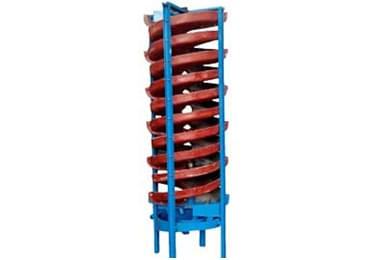
The spiral chute is a mineral processing device that creates a centrifugal flow film on its inclined spiral surface, leveraging differences in specific gravity, particle size, and shape between valuable minerals and gangue. Within the combined force field of gravity and centrifugal force, separation is achieved by exploiting the varying gravitational forces, hydrodynamic pressures, and frictional resistances acting on different particles. Spiral chutes are ideal for processing fine-grained iron ore, ilmenite, chromite, pyrite, zircon, rutile, monazite, phosphorite, tungsten ore, tin ore, tantalum ore, and niobium ore with particle sizes ranging from 0.3 to 0.02 millimeters, as well as other non-ferrous metals, rare metals, and non-gold minerals with differing densities. Working Principle The spiral chute is primarily composed of six components: a feed distributor, a feed trough, a spiral trough, a concentrate discharge trough, a receiving hopper, and a support frame. When slurry of a specific concentration is fed into the upper section of the spiral separator, it rotates downward along the spiral trough. Coarser ore particles settle first at the bottom of the trough, while finer particles flow in the upper layer of the slurry. Due to the differing trajectories of ore particles with varying densities within the chute, particles of different densities can be intercepted at distinct positions along the spiral, achieving effective separation. Additionally, the water flow dynamics within the spiral chute facilitate material mixing and uniform distribution, thereby enhancing mineral processing efficiency. Features 1. The end of the spiral chute separately intercepts fine concentrates, middlings, and tailings. 2. No flushing water is added during the selection process. 3. Spiral blades are constructed from fiberglass, offering lightweight strength and durability. 4. Spiral chutes feature high processing capacity, simple structure, and low operating costs.
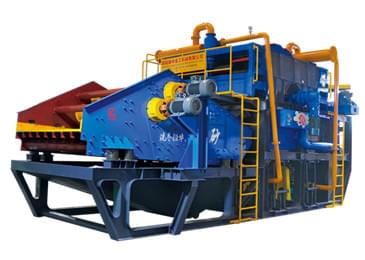
LZZG silica scrubbing machine features an efficient impeller design that precisely controls turbulence to achieve effective attrition scrubbing. It maximizes the removal of surface films, coatings, and slimes without reducing particle size. The incoming materials undergo multiple washing cycles to ensure optimal cleaning performance, significantly enhancing product value and increasing the recovery rate of viable material. The LZZG silica scrubbing machine is primarily used for processing glass sand, fracturing sand, ore, clay, iron ore, and other products with stringent requirements for color and turbidity. Working principle During operation, mixed materials first enter the scrubbing unit for thorough friction and washing. Two opposed shaft-mounted turbine impellers generate counter-flowing slurry, creating high-impact collisions between particles. The ideal solid concentration ranges from 70% to 80%, depending on the specific mineral characteristics. Multiple friction units can be connected in series based on material properties. Scrubbed overflow materials then enter the impeller sand washer for secondary cleaning, after which the washed clean materials proceed to the dehydration area. Typically, hydrocyclones are also employed to recover fine materials from the overflow, maximizing overall yield and benefits. Features 1. Simple equipment structure and small floor area; 2. Efficient impeller design, high washing efficiency; 3. Multiple cleaning, good product turbidity and high product quality; 4. Use the interaction between particles to scrub and decompose mud and reduce equipment wear; 5. Maximize the recovery rate.
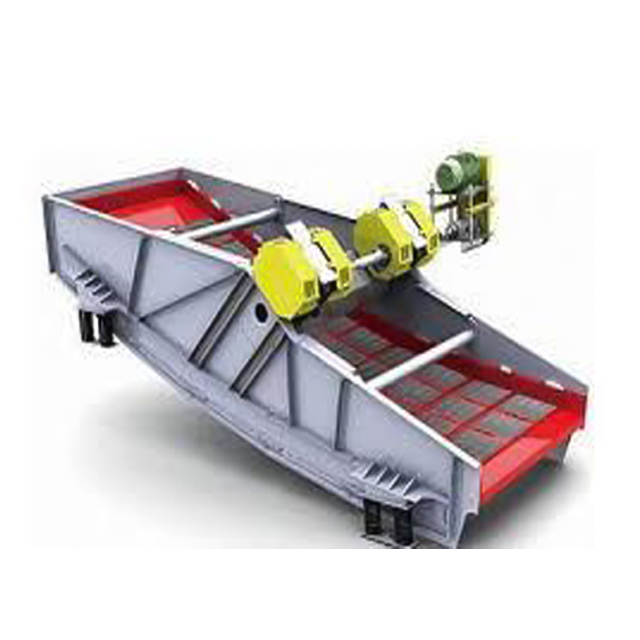
The JR banana screen is ideal for screening, dewatering, medium-density separation, desliming, and other processing operations involving coal, gravel aggregates, minerals, and various bulk materials. This series features customizable configurations—including varying screening areas, mesh aperture sizes, numbers of screen deck sections, and inclination angles—tailored to specific applications and throughput requirements. Available in single-deck and double-deck models, the working area ranges from 5.7 m² to 30.2 m². With over 20 primary specifications and models, this equipment meets the production demands of diverse mining operations and coal preparation plants. Structure The Banana vibrating screen consists primarily of a screen box, screen mesh, vibration exciter, damping springs, and a lower support frame. It utilizes a motor and an exciter as the vibration source. The exciter comprises an eccentric shaft, pulley, bearing, and bearing seat. Driven by the motor, the eccentric shaft rotates to generate centrifugal inertial force, thereby inducing vibration in the screen box. Technical Characteristics 1. The banana sieve features high screening efficiency and significantly greater processing capacity than traditional grading screens, making it an advanced screening machine. 2. Vibrator: Utilizes the world-leading JR-type box vibrator with splash lubrication and a built-in oil channel within the housing to ensure comprehensive bearing lubrication. It employs high-precision helical gears and specialized bearings designed for vibratory equipment. The drain plug is magnetic, and an external transparent organic plastic sight glass allows for easy monitoring of the oil level. Special measures are taken to ensure smooth operation of bearings and gears; the vibrator noise level is below 75 dB, and the bearing temperature remains under 50°C. 3. The exciter beam adopts a three-I-shaped beam structure, overcoming the issue of weak force distribution in the center of conventional square beams. Equipped with reinforcing rib plates, it offers high rigidity and lightweight design, with stress relief treatment applied after welding. 4. The beam surface can be coated with a polyurethane protective layer, providing resistance to erosion and abrasion for extended service life. 5. Shaped cutting and drilling of the side plates are performed by high-precision CNC machines to ensure dimensional accuracy. The side plates feature no weld seams to avoid stress concentration, thereby preventing cracking. 6. The screen surface can be secured using two methods: a middle rail seat design with polyurethane-pressed wood at both ends, or a middle-pressure plate design with polyurethane-pressed wood at both ends. Both configurations support the installation of either polyurethane or stainless steel…
We pride ourselves in our commitment and the level of service offered and aim to work closely with customers, to ensure we meet your expectations. Our objective is to keep your business operations running as smoothly as possible on a day-to-day basis.
If you need the latest price list, please leave us a message here! We guarantee that your information will not be divulged to the third parties, and we will reply to you within one working day, thank you.
We are here for your questions anytime 24/7, welcome your consultation.
The latest sand washer price.
Installation and maintenance.
Screening
Sand Washing Machines
Sludge Treatment
Sand Recycling Machines
Address: Shuangyue Road, Changdai Town, Mengjin County, Luoyang, China
Email: export@lylzzg.com
Tel: +86-18736301510


 日本語
 Русский
 中文
 Español
 Français
 Português
 العربية
 Tiếng Việt
 Deutsch
 한국어
 Türkçe
 বাংলা
 हिन्दी
 Bahasa Melayu
 Kiswahili