
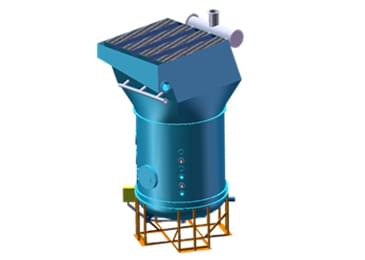
LSF hydraulic classifier is part of the family of hindered settling classification equipments. It adopts the mechanism of “layer flow high shear rate”, which solves the problem that traditional technology cannot adapt to the change of feed particle size, resulting in the loss of fine material recovery.
LZZG series introduced products to absorb foreign advanced technology, and designed combined with sand field actual situation. It can effectively reduce the loss amounts of fine material; solve problems of end product such as relatively high fineness modulus and relatively low stone powder content. The fine material can be recycled as high as 95%, with incomparable technical and economic advantages.
| Model | Feeding Size (mm) | Capacity (t/h) | Overall Size (mm) |
| LSF 1100 | 0.04~2 | 40 | 4134*1987*6126 |
| LSF 2000 | 0.04~2 | 100 | 4847*2845*6234 |
| LSF 3000 | 0.04~2 | 200 | 6456*3665*6915 |
| LSF 3600 | 0.04~2 | 300 | 7280*4484*7525 |
The LSF hydraulic classifier is part of the family of classification equipment. It adopts the “layer flow high shear rate” mechanism, solving the problem where traditional technologies cannot adapt to changes in feed particle size, resulting in the loss of fine material recovery. The LSF hydraulic classifier offers significant advantages in capacity, adaptability, and efficiency, delivering higher recovery rates and superior classification performance.
The LSF hydraulic classifier can be applied to aggregate processing, coal mud separation, quartz sand production, ceramic raw material processing, silica sand processing, and various metal mine tailings sorting and processing.
Working principle
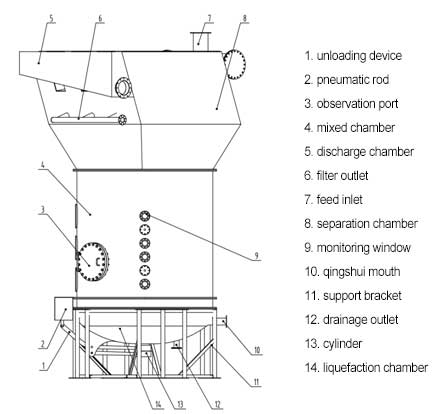
The LSF hydraulic classifier separates small particles based on differences in density or particle size. It combines a traditional fluidized bed separator with a set of parallel inclined plates that form a thin-film channel. Fine particle materials enter the interior of the thin-film chamber through the feed inlet, thus entering the mixing chamber located below the thin-film, where the material is fluidized to form a slurry under the action of the fluidized bed. Materials with high density will sink due to gravity, while materials with low density will float up.
At the bottom of the mixing chamber, a high-density sediment solid bed forms. This dense bed layer is maintained in a suspended state by fluidized water jets entering from the chamber base. The turbulent motion generated by these upward-injected fluidized waters sorts coarse and fine low-density particles trapped within the dense fluidized bed, causing them to rise into the thin-film chamber above. Meanwhile, high-density particles sink to the bottom of the fluidized bed under gravity and migrate toward the discharge cylinder at the base of the liquefaction chamber.
The LSF supports remote monitoring and control via intelligent systems. Once preset parameters are reached, the automated unloading device can be opened or closed by the control cylinder for efficient discharge.
Features
1. Customizable to meet specific on-site requirements;
2. Easy to transport and install;
3. Simple adjustment, flexible process flow, and higher efficiency;
4. Compact structure, user-friendly operation, and suitable for any production line layout;
5. Remote monitoring capability with a high degree of automation;
6. Reduced maintenance costs.
There are no relevant articles.
We pride ourselves in our commitment and the level of service offered and aim to work closely with customers, to ensure we meet your expectations. Our objective is to keep your business operations running as smoothly as possible on a day-to-day basis.
If you need the latest price list, please leave us a message here! We guarantee that your information will not be divulged to the third parties, and we will reply to you within one working day, thank you.
We are here for your questions anytime 24/7, welcome your consultation.
The latest sand washer price.
Installation and maintenance.
Screening
Sand Washing Machines
Sludge Treatment
Sand Recycling Machines
Address: Shuangyue Road, Changdai Town, Mengjin County, Luoyang, China
Email: export@lylzzg.com
Tel: +86-18736301510


 日本語
 Русский
 中文
 Español
 Français
 Português
 العربية
 Tiếng Việt
 Deutsch
 한국어
 Türkçe
 বাংলা
 हिन्दी
 Bahasa Melayu
 Kiswahili