
Date: Nov. 04, 2021
Wastewater treatment in sand and gravel plants presents a complex challenge, with many customers seeking guidance on how to manage this process correctly and effectively. To achieve optimal results, it is essential first to identify the sources of wastewater and then customize a reasonable treatment plan based on those specific origins.
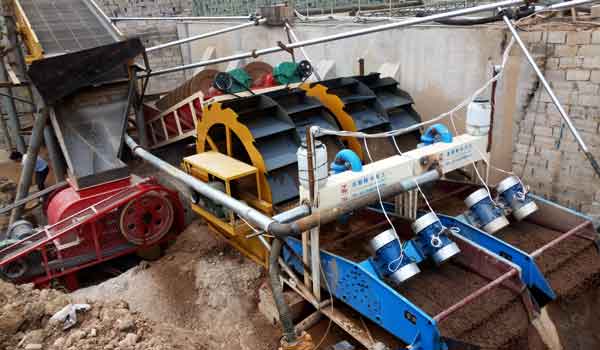
1. Washing Wastewater: This stream contains significant amounts of fine-grained ore, mud, sand, and minor quantities of ore particles. A can be employed for recycling and washing purposes.
2. Crushing Process Wastewater: This type contains ore particles that can be recovered through precipitation.
3. Gravity Separation and Magnetic Separation Wastewater: Primarily consisting of mineral particles and suspended solids, this water can generally be reused after clarification.
4. Flotation wastewater: This primarily originates from overflow water and tailings pond discharge generated after concentrate and tailings undergo a two-stage dewatering process involving thickening and filtration. It contains flotation reagents and a small quantity of suspended solids. Tailings water can be processed using a combination of thickeners and filter presses for pressure filtration and sedimentation, enabling dry discharge of solid waste and secondary environmentally friendly reuse of the tailings.
1. Screening: Material is conveyed to a circular vibrating screen or drum screen via belt conveyor, where it is separated into several fractions of different sizes.
2. Cleaning and dewatering: The undersized material that meets specifications enters the cleaning water tank of an integrated sand washing and recycling machine. As the sand washing wheel buckets rotate, they stir the material within the tank for thorough cleaning, effectively removing surface impurities. Subsequently, coarse-grained materials are transported by dredging wheels to a dewatering screen for final dewatering.
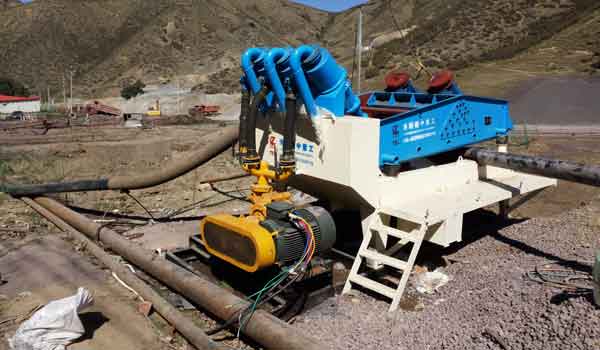
3. Fine Material Recovery: The overflow from the integrated machine enters the tailwater collection tank via pipeline. A slurry pump then transfers this tailwater to the separator, where sediment is separated out. Recovered fine materials are discharged onto the dewatering screen, while coarse materials are uniformly mixed and discharged after dehydration. The discharge port connects to a belt conveyor to transport finished products to the designated location.
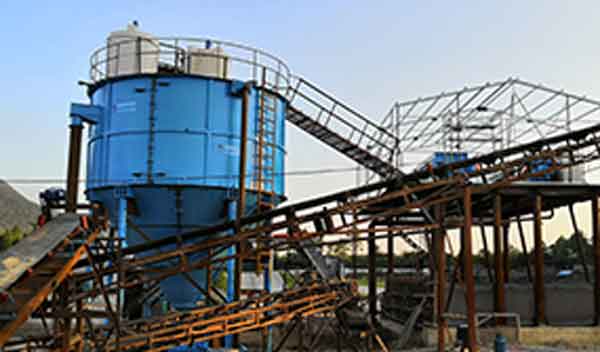
4. Solid-Liquid Separation: Simultaneously, the slurry processed by the separator contains no more than 5% suspended solids. This effluent is discharged into the sewage tank, from which the tailwater is pumped into the filter tank for mud-water separation operations. After the filter tank treats approximately 80% of the tailwater into clean water, it flows directly into the clean water tank via the overflow.
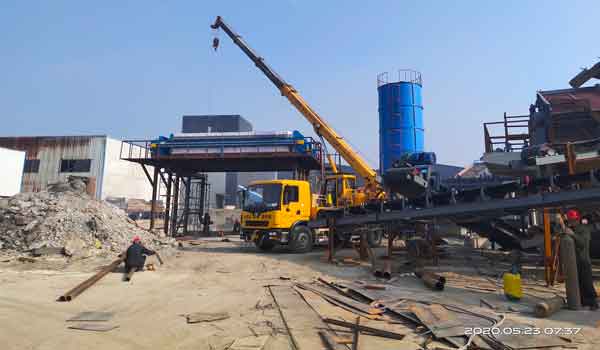
5. Sludge dewatering: The concentrated slurry is pumped into plate-and-frame filter presses located at the bottom of the filtration tank. The filter press compresses the slurry into a mud cake, facilitating dry stacking, landfill disposal, or other beneficial reuse applications. Following pressure filtration, the clarified water flows into a clean water tank, enabling full water recycling and achieving zero discharge throughout the entire process.
LZZG’s sand and gravel wastewater treatment solutions are designed to maximize site utilization with compact layouts, minimal footprint, and straightforward operation and management. Our systems deliver high wastewater recovery rates while ensuring consistent quality of reused water. If you require a customized wastewater treatment plan, please leave a message detailing your material characteristics and site location. Our professional technical team will design the optimal solution and configure the equipment specifically for your needs.
Please enter your inquiry and contact. We will reply you as soon as possible.
We are here for your questions anytime 24/7, welcome your consultation.
The latest sand washer price.
Installation and maintenance.
Screening
Sand Washing Machines
Sludge Treatment
Sand Recycling Machines
Address: Shuangyue Road, Changdai Town, Mengjin County, Luoyang, China
Email: export@lylzzg.com
Tel: +86-18736301510


 日本語
日本語 Русский
 中文
中文 Español
 Français
 Português
 العربية
 Tiếng Việt
 Deutsch
 한국어
한국어 Türkçe
 বাংলা
বাংলা हिन्दी
 Bahasa Melayu
 Kiswahili